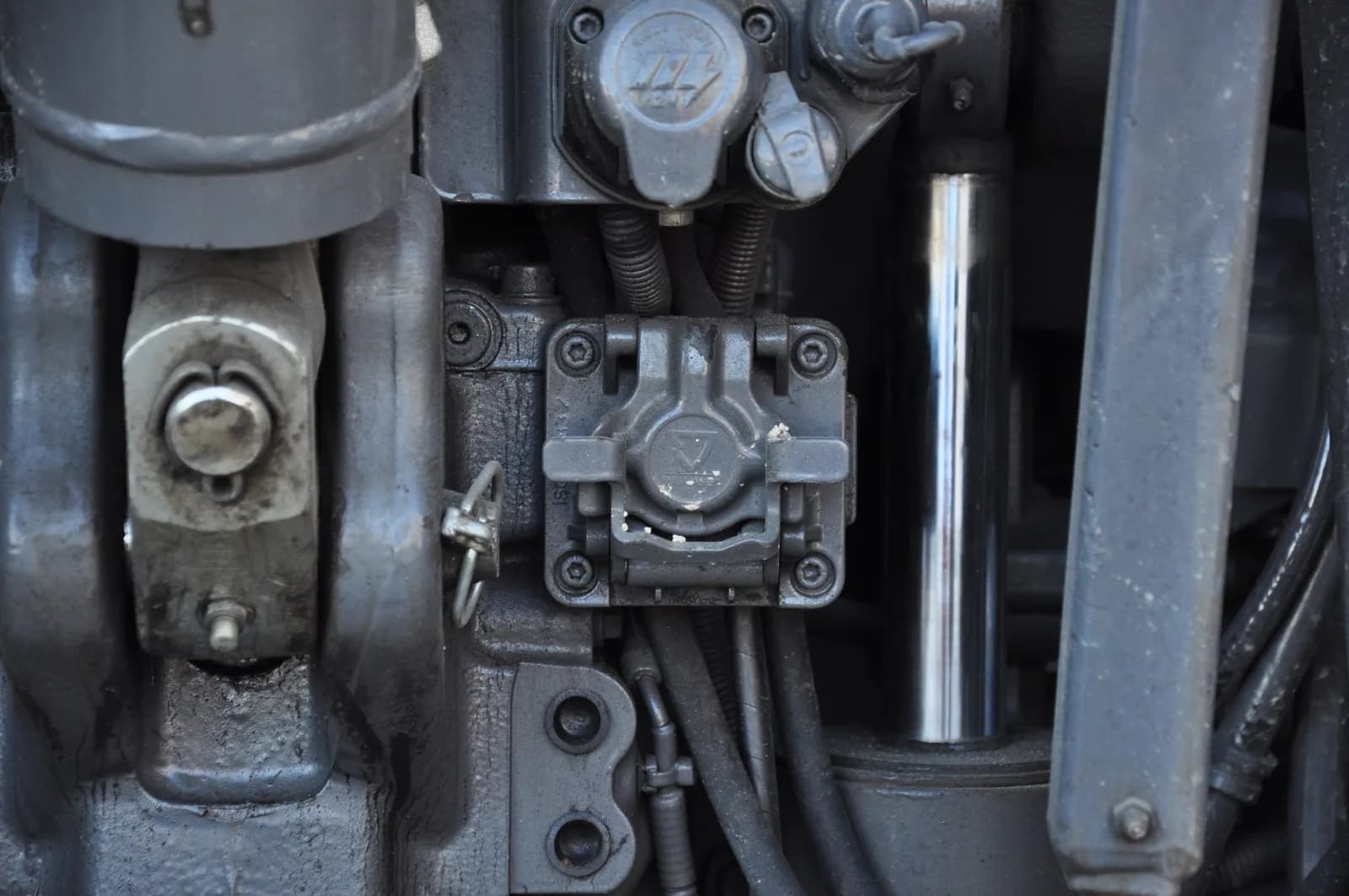
In short: A tractor has two ISOBUS plugs, and they do not fit each other: the rear external connector for implements, and the in-cab connector for displays, diagnostics and cab-mounted modules. Both have 9 contacts and are the same on every tractor brand. If the device lives on the implement, use the rear plug. If it lives in the cab, use the in-cab plug.
An ISOBUS plug connects a relay module, finishes a harness for an older implement, or replaces the one that got driven over. Before you order, work out which plug: a tractor has two different ISOBUS connectors and they do not mate with each other.
Each one is covered below with its purpose, the ratings from the manufacturer's drawing, the cable it takes and where to buy it. Neither changes between tractor brands. For pin-by-pin wiring, the ISOBUS connector pinout guide has the tables.
The two ISOBUS connectors on a tractor
ISO 11783-2 defines two connectors. Both have 9 contacts. They are different parts with different shells, and a plug made for one will not fit the other.
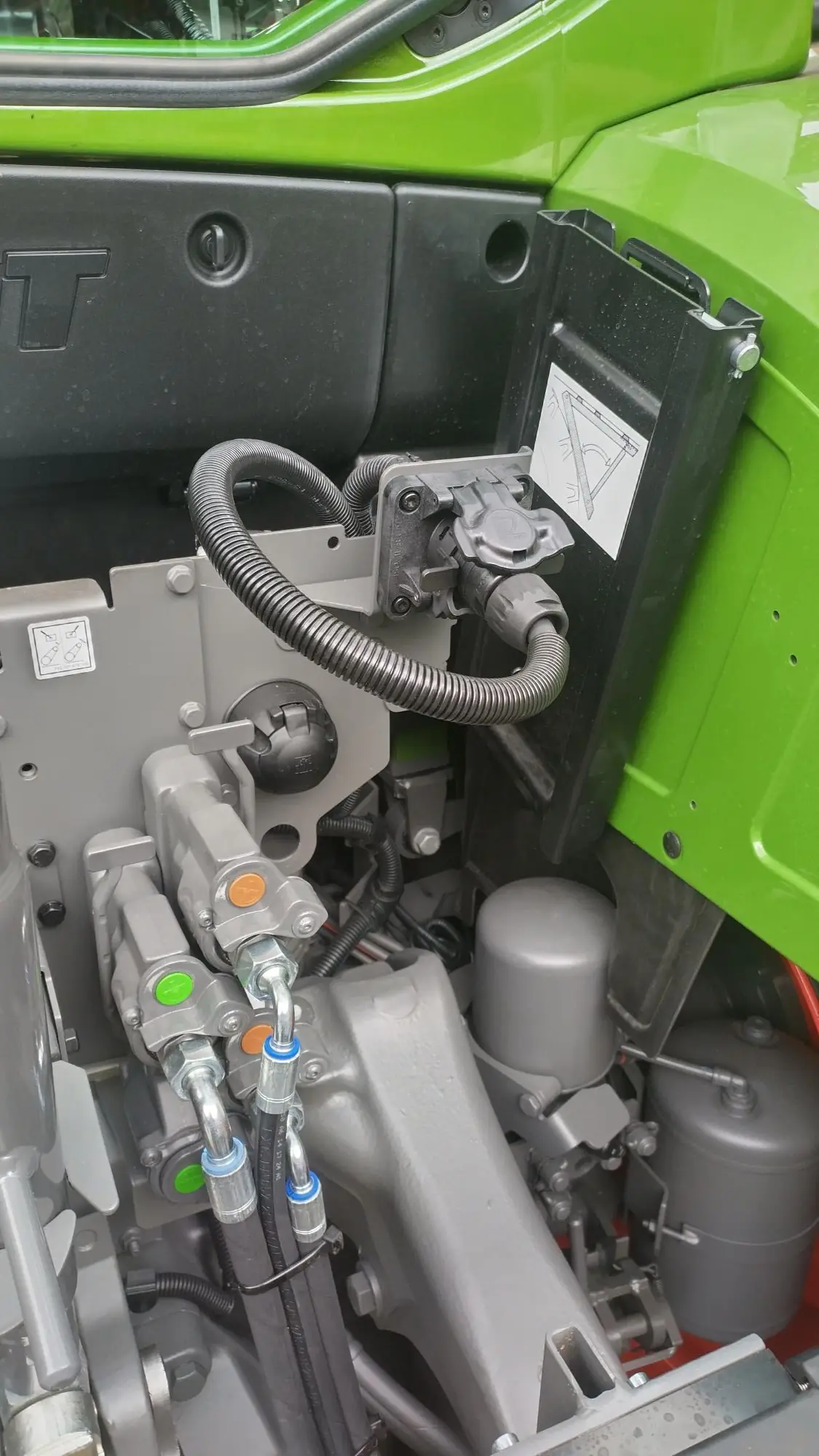
The rear external ISOBUS connector sits on the outside of the tractor, near the hydraulic couplers and the 3-pin, 7-pin and signal sockets. This is where an implement plugs in. Some tractors carry a second one at the front for front-mounted implements. The standard calls it the Implement Bus Breakaway Connector (IBBC), because it is built to separate cleanly if an implement comes off the hitch. You will see that name in parts catalogues and datasheets.
The in-cab ISOBUS connector is inside the cab, on the right side of the operator's seat near the armrest or B-pillar. It gives cab-mounted devices access to the ISOBUS network: extra displays, diagnostic tools, relay modules.
| Rear external ISOBUS connector | In-cab ISOBUS connector | |
|---|---|---|
| Where | Outside, rear (or front) of the tractor | Inside the cab |
| Contacts | 9 | 9 |
| ISO 11783-2 section | §5 | §4 |
| Carries | CAN, ECU power, and a battery supply the tractor fuses at 60 A | CAN and ECU power |
| Use it for | Implements, anything mounted outside the cab | Displays, diagnostics, cab-mounted modules |
The rule of thumb: if the device lives on the implement, use the rear plug. If it lives in the cab, the in-cab plug is the shorter run and keeps the cable out of the back window.
The 9-pin rear ISOBUS plug
The mating plug for the rear socket is a 9-contact circular connector with bayonet locking. A common part is the Amphenol AHDP06-24-91S family. The "24" in the part number is the shell size, not the pin count. The connector has 9 contacts, in three sizes.
These figures come from the Amphenol drawing for the AHDP06-24-91S-BS1:
| Spec | Value |
|---|---|
| Standard | ISO 11783-2 |
| Contacts | 9: 2 × size 8, 2 × size 12, 4 × size 16, 1 × size 16 bridged |
| Rated voltage | 24 V DC |
| Sealing | IP67 / IP6K9K when mated |
| Temperature | −40 °C to +125 °C |
| Locking | Bayonet |
| Cable diameter | 14–18 mm |
| Mating cycles | ≥100 |
| Housing | Polyamide, black, UL94V-0 |
Current per contact
What each contact carries depends on its size and the conductor you crimp into it. Ratings at 40 °C:
| Contact size | Pins | Conductor | Current |
|---|---|---|---|
| Size 8 | 1 (ground), 3 (power) | 6 / 10 / 16 mm² | 45 / 60 / 75 A |
| Size 12 | 2 (ECU ground), 4 (ECU power) | 2.5 mm² | 15 A |
| Size 16 | 6, 7 (TBC), 8, 9 (CAN H, CAN L) | 0.5 mm² | 5 A |
Pin 5 is the bridged size 16 contact. It is bridged at the factory, so you do not wire it.
The two size 8 contacts are the heavy ones. Pin 3 carries the battery supply that the tractor fuses at 60 A, and pin 1 is its chassis ground return. The CAN pair sits on the small size 16 contacts. Full functions for every pin are in the pinout guide and drawn on the docs page.
The in-cab ISOBUS plug
This is a different part. The mating plug for the in-cab socket is the TE 206708-1, a 9-position circular plug in shell size 13. It takes TE 1-66101-9 socket contacts for 18-16 AWG wire, and the TE 206966-9 cable clamp for strain relief.
All nine contacts are the same part. One crimp tool, one wire range.
ISOBUS Block uses four of the in-cab pins: pin 2 (CAN_L), pin 4 (CAN_H), pin 7 (BAT+) and pin 9 (GND). The full layout is in the in-cab connector pinout.
ISOBUS cable and harness
The connector tells you what cable to buy.
For the rear plug, conductor size follows the contact size. The Amphenol ratings above are given for 0.5 mm² on the size 16 contacts, 2.5 mm² on size 12, and 6, 10 or 16 mm² on size 8. The outer jacket has to be 14–18 mm across to seal in the plug's cable entry. For the in-cab plug, use 18-16 AWG conductors to match the contacts.
Run CAN_H and CAN_L as a twisted pair, all the way to the contacts. Untwisting a long tail at the plug is where noise gets in. The bus also needs 120 ohm termination at each physical end. If you are adding a device to an existing network, you do not add a terminator yourself.
Keep the run as long as the install needs and no longer. Every extra metre and every join is one more place for a fault, and it is the CAN pair that suffers first.
Ready-made harness or build your own
Ready-made ISOBUS extension cables and implement harnesses exist. They suit a standard job: a fixed length, a known plug at each end. Building your own suits everything else: the cable length your machine needs, a routing that suits the frame, and whatever sits at the far end.
Retrofitting an ISOBUS harness
When people talk about retrofitting an ISOBUS harness, the tractor side is already done. The socket is standard, so the plug that goes into it is standard too. The implement side is yours: where the cable runs, how it is clamped, and what it connects to. The ISOBUS retrofit guide walks through that side.
ISOBUS connector by tractor brand
| Brand | Rear external connector | In-cab connector |
|---|---|---|
| John Deere | ISO 11783-2, 9-pin | ISO 11783-2, 9-pin |
| Fendt | ISO 11783-2, 9-pin | ISO 11783-2, 9-pin |
| Case IH | ISO 11783-2, 9-pin | ISO 11783-2, 9-pin |
| New Holland | ISO 11783-2, 9-pin | ISO 11783-2, 9-pin |
| CLAAS | ISO 11783-2, 9-pin | ISO 11783-2, 9-pin |
| Valtra | ISO 11783-2, 9-pin | ISO 11783-2, 9-pin |
| Massey Ferguson | ISO 11783-2, 9-pin | ISO 11783-2, 9-pin |
| Kubota | ISO 11783-2, 9-pin | ISO 11783-2, 9-pin |
The standard exists so the plug is the same on every brand. A John Deere ISOBUS plug is the same part as a Fendt one. What does vary is whether a given model has ISOBUS at all, and whether the in-cab socket is fitted as standard or as an option. Check the specific model.
Where to buy an ISOBUS plug
The connectors come from a handful of makers. You buy them from the makers' distributors or from ag parts suppliers.
- Erich Jaeger makes ISOBUS plugs, sockets and cables for agricultural machinery.
- Amphenol makes the AHDP06 family for the rear plug. The AHDP06-24-91S housing ships without contacts, so order them separately in the sizes you need.
- TE Connectivity makes the in-cab plug (206708-1), its contacts (1-66101-9) and the cable clamp (206966-9). Electronics distributors stock them by part number.
- Ag parts suppliers such as Sparex and Granit, and your tractor dealer's parts counter, are the usual places to ask for ISOBUS plugs and cables.
What an ISOBUS plug costs
Ask the dealer. The price depends on the contact sizes and on whether contacts are included with the housing. Compare like with like: a bare housing, a housing with contacts, and a plug already on a length of cable are three different products.
Before you order, check:
- Which socket: rear external or in-cab.
- Whether the contacts are included.
- That the contact sizes match your conductors.
- That the cable entry matches your jacket diameter.
- That you have the right crimp tool.
What ISOBUS Block supplies
ISOBUS Block is an 8-channel relay module that connects to either ISOBUS socket. It offers two connector kits and an ISOBUS cable as add-ons next to the module's Add to cart button. They are not sold on their own.
In-Cab Connector Kit, for the in-cab ISOBUS connector:
- 1 × TE 206708-1, 9-position circular plug, shell size 13
- 1 × TE 206966-9, cable clamp / strain relief
- 9 × TE 1-66101-9, socket contacts, 18-16 AWG, bright tin
- Pinout diagram and crimping instructions
External Connector Kit, for the rear or front external ISOBUS connector:
- 1 × Amphenol AHDP06-24-91S-BS1-K06S, female cable connector to ISO 11783-2, for 14–18 mm cable
- Contacts (Amphenol ships this housing without them, so they are in the kit)
- Pinout diagram and crimping instructions
In both kits the contacts come loose. You crimp them onto your own cable, cut to the length your machine needs. The in-cab kit takes a standard 18-16 AWG crimp tool. There is no ready-made harness to buy instead. For the external side, the ISOBUS cable is also available: bare HELUKABEL ISOBUS PUR in 3, 6 or 10 m, which fits the External Connector Kit's plug.
The kits carry CAN and power to the module. The relay outputs are wired separately, from the module's screw terminals to your work lights, solenoid valves or diverter valve. Module in the cab: in-cab kit. Module in a weatherproof box on the implement: external kit. The bare module's housing is IP20, so outdoors it needs an enclosure.
Y-splitters, extension cables and bridge plugs
Three adapters come up when the socket is too far away or one socket is not enough.
Extension cables. Fine when the implement's plug does not reach the socket. Keep the extension short, keep CAN as a twisted pair, and on the rear socket keep the power conductors the same size as the rest of the run. Pin 3 carries the load supply the tractor fuses at 60 A, pin 1 its ground return, and a thinner extension costs you voltage at the far end.
Y-cables on the rear socket. A Y-cable puts two devices on one socket, usually when a tractor without a front socket has to run two ISOBUS implements at once. Both then share that socket's ECU power and its one fused load supply, so add up what they draw. The bus must still end at exactly two terminators: one in the tractor, one at the far end. Two implements that each bring their own TBC make three. The ISOBUS terminator guide shows how to measure it.
In-cab Y adapters. These turn one in-cab socket into two, for example for a second terminal, or a cab-mounted relay module next to a device that is already plugged in.
Bridge plugs. On tractors where the in-cab socket sits in the middle of the bus, an unused in-cab port takes a bridge plug that keeps the bus continuous. It is not a terminator.
Frequently Asked Questions
Is the ISOBUS plug the same on John Deere and Fendt?
Yes. Both brands use the ISO 11783-2 connectors, so a rear plug that fits a John Deere fits a Fendt, and the same goes for the in-cab plug. The only difference is where the socket is mounted. Deere's display menus and limits are in the John Deere ISOBUS guide.
What is an IBBC connector?
It is the standard's name for the rear external ISOBUS connector: Implement Bus Breakaway Connector. It is the 9-pin socket at the back of the tractor where implements plug in, built to separate cleanly if the implement comes off.
Which cable do I need for ISOBUS?
Match the cable to the plug. For the rear plug, the jacket must be 14–18 mm across, with conductors sized to the contacts: 0.5 mm² for CAN, 2.5 mm² for ECU power and ground, 6 to 16 mm² for the main power pair. For the in-cab plug, use 18-16 AWG. Run CAN as a twisted pair.
Where is the ISOBUS socket on a tractor?
The rear external socket is at the back, near the hydraulic couplers. The in-cab socket is inside the cab, on the right side of the operator's seat near the armrest or B-pillar. Some tractors also have a front external socket.
How much does an ISOBUS plug cost?
Ask your dealer or parts supplier. The price depends on the contact sizes and whether contacts are included, since some housings, including the Amphenol AHDP06-24-91S, ship without them.
Can I use a Y-cable on the ISOBUS socket?
Yes, with two checks. Both devices share the socket's ECU power and its fused load supply, so their combined draw has to fit. And the bus must still end at exactly two terminators: with everything connected and switched off, you should read about 60 ohms between CAN H and CAN L.
Need an ISOBUS relay module for controlling solenoids, work lights, or hydraulic valves? ISOBUS Block provides 8 relay outputs controlled directly from your tractor's Virtual Terminal display.