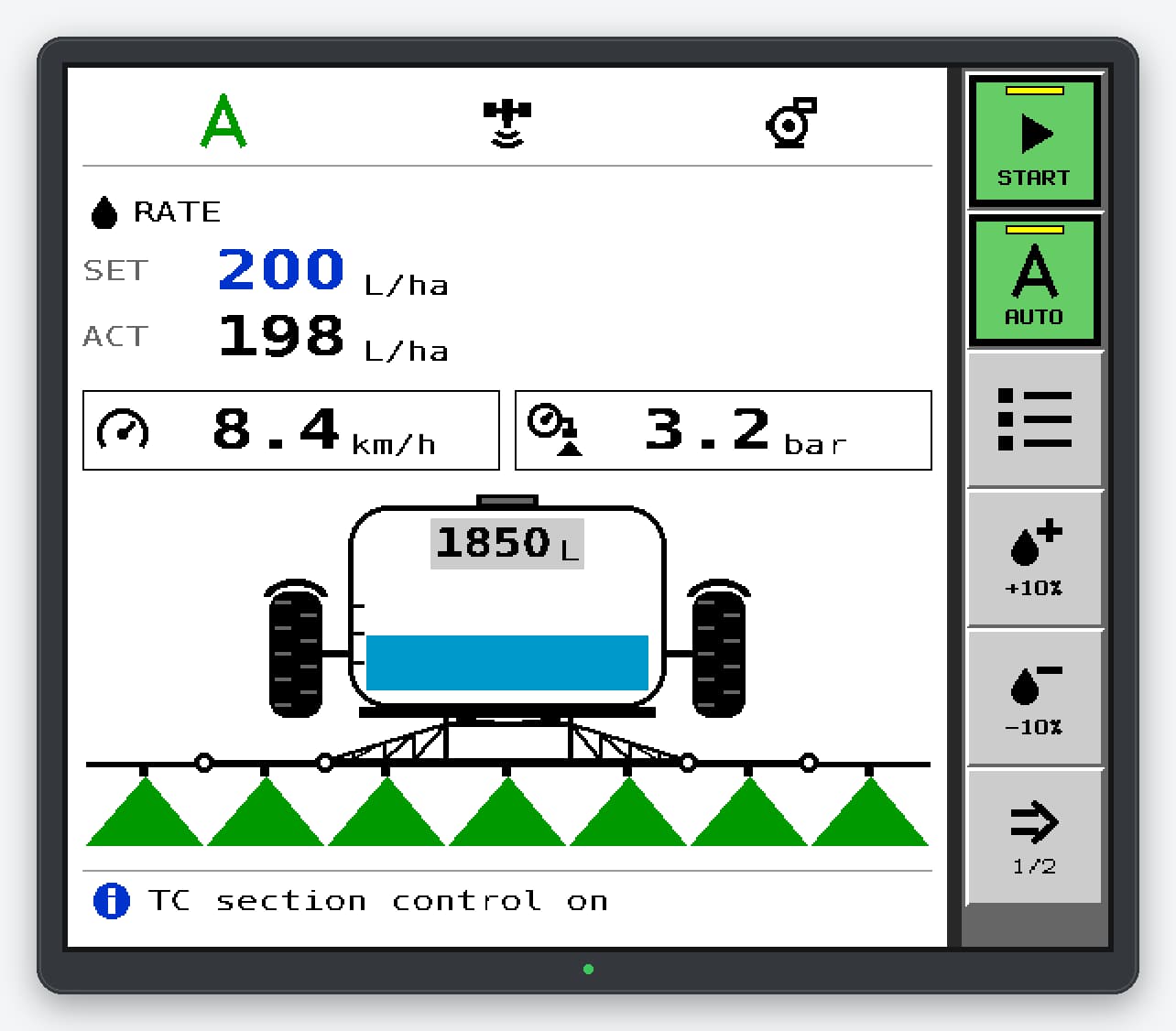
The ISOBUS ECU on an implement is the job computer on the machine: the box that makes a sprayer, spreader or seed drill show up on the tractor's screen and do what the operator asks. Below: what it does, what sits in and around it, and which decisions you need to make before anyone writes a line of software.
What an ISOBUS implement ECU does
ISOBUS is ISO 11783, the standard that lets any compliant tractor run any compliant implement from one screen. The implement ECU is the implement's side of that conversation. It has five jobs.
It talks to the tractor over CAN
The ECU sits on the implement and connects to the tractor's ISOBUS network, a CAN bus running at 250 kbit/s. The physical link is the 9-pin ISO 11783-2 connector on the back (or front) of the tractor. On power-up it claims an address on the bus (ISO 11783-5) and becomes one participant among several: tractor, terminal, maybe a second implement.
It carries its own screens
The implement's operator interface lives in the ECU as a Virtual Terminal object pool: every screen, button, number field, alarm and icon. On connection the ECU uploads that pool to whichever terminal is in the cab, and the terminal draws it. That is why one sprayer runs on terminals from different tractor brands. The Virtual Terminal explained post covers this from the operator's side.
It reads sensors and drives outputs
Boom height, wheel speed, flow, pressure, fill level: the ECU reads them. Proportional valves, solenoids, motors, lights: the ECU drives them. The control logic in between runs here.
It can document and switch sections (Task Controller)
If the implement should record what it applied, or switch sections from a map, the ECU acts as a Task Controller client (ISO 11783-10). There are three functionalities: TC-BAS for totals, TC-GEO for position-based data and prescription maps, and TC-SC for automatic section control. Each is a separate decision.
It can publish joystick functions (AUX-N)
The ECU can offer auxiliary functions that the operator assigns to buttons on the tractor's joystick or armrest. Fold, unfold, raise the boom. The AUX-N complete guide goes through how assignment works in the cab.
What is physically in and around the ECU
The ECU is a sealed housing on the implement frame, exposed to vibration, washdown, heat, cold and whatever chemical the machine carries. Three kinds of connection leave it.
Power and CAN from the tractor. The implement plugs into the tractor's rear external ISOBUS connector. On that connector, pin 4 is ECU power and pin 2 is ECU ground, the supply for the implement's electronics. Pins 8 and 9 carry CAN H and CAN L. Pin 3 (Power) and pin 1 (Ground) are the higher-current pair for actuators. Full pin tables for both tractor sockets are in the ISOBUS connector pinout guide.
The machine-side wiring. This is the manufacturer's part. On many projects the ECU comes with flying leads that the OEM wires into its own harness: sensors, valves, motors, lights. The inputs and outputs are defined per machine.
The software inside. The ISOBUS protocol stack, the object pool, the control logic and the diagnostics. What that work breaks down into is covered in what an OEM ISOBUS project contains.
Implement ECU vs TECU, terminal and gateway
Four device types show up in every ISOBUS conversation, and they get mixed up.
| Device | Where it sits | What it does | Who supplies it |
|---|---|---|---|
| Implement ECU | On the implement | Reads the implement's sensors, drives its valves, holds its object pool, optionally TC client and AUX-N | The implement manufacturer |
| Tractor ECU (TECU) | In the tractor | Publishes tractor data on the bus: ground speed, PTO speed, hitch position | The tractor manufacturer |
| Universal terminal (VT) | In the cab | Draws the implement's screens, takes touch and softkey input, often hosts the Task Controller | The tractor maker or an aftermarket supplier |
| Gateway | Between ISOBUS and another network | Moves data on or off the bus: telematics, protocol conversion | A third party |
The terminal is the screen. The TECU is the tractor telling everyone what it is doing. The implement ECU does the work on your machine. The ISOBUS gateway post covers the fourth category.
Approvals, and why EMC is the expensive one
- CE marking. The declaration that the product meets the applicable EU directives.
- Automotive EMC (E-mark). Vehicle electronics are tested for what they emit and what interference they tolerate. The number identifies the approving country; E17 is Finland.
- RoHS 2. The restriction on hazardous substances in electrical equipment.
EMC is the one that hurts: lab time, test fixtures, and a redesign loop if the unit fails. Develop your own controller and you pay for that. Pick one that already carries its EMC approval and the work is behind you. Ask for the certificates at the start.
AEF conformance is separate. The Agricultural Industry Electronics Foundation tests ISOBUS functionality, and it is the finished machine that gets tested.
What to specify before the project starts
You can write all of this down before any code exists, and every item changes what the ECU has to do.
- Sensors and actuators. Every sensor and every valve, motor and light on the machine, with its signal type. Analog, frequency, switched, proportional, on/off. This sets the I/O the ECU needs.
- Operator functions. What the operator does from the seat, in plain words. "Fold the left wing." "Set the application rate." "See the tank level." These become the screens.
- Alarms. What can go wrong, and what the operator reads when it does. "No signal from the boom height sensor" is an alarm. "Error 0x3F" is not.
- Joystick control. Whether the operator should run functions from the tractor's buttons through AUX-N, and which functions.
- Task Controller. Whether the machine needs documentation (TC-BAS), map-based rates (TC-GEO) or automatic section control (TC-SC). Each is a separate yes or no.
- Environment. Washdown, fertiliser and chemical exposure, vibration, where on the frame the ECU will be mounted.
- The tractors your dealers sell. Terminals from different brands behave differently on ISOBUS. Knowing which ones your customers use tells you which ones to test against.
- Your brand on the screen. Logo, colours, naming.
A good supplier will ask for this list anyway. The wider picture of what the machine itself needs, beyond the ECU, is in what an implement needs to be ISOBUS-ready.
Where a turnkey partner fits
You can build all of this in house: hardware, EMC testing, the ISOBUS stack, the screens, testing against every terminal your dealers meet. Many manufacturers would rather spend those hours on the machine.
That is the work ETERVO Oy, the company behind ISOBUS Block, takes on for implement manufacturers. ETERVO develops and maintains the ECU software, the Virtual Terminal interface and the integration with your machine. It runs on a control unit designed, tested and built in Finland: a sealed IP69 full-metal aluminium housing, rated for mechanical shock, vibration, heat, cold and chemical exposure, with CE, E17 automotive EMC and RoHS 2 approvals already in place. It comes with flying leads you wire to your own sensors and valves, with the I/O defined per project.
The software covers Virtual Terminal, AUX-N and Task Controller, built on AEF certified ISOBUS software libraries. AEF certification of your finished machine is a separate step. The operator interface carries your brand. The software is tested on a bench with the same sensors and valves as your machine, wired the same way, and on real tractors. Support runs for as long as the machine is in production. Code ownership and licensing are agreed per project. The details are on the OEM page.
ISOBUS Block itself is a different product: a relay module an owner adds to an existing machine to get switched outputs on the tractor screen and joystick.
FAQ
What is an ISOBUS ECU?
An ISOBUS ECU is an electronic control unit that connects to the tractor's ISO 11783 CAN network. On an implement it is the job computer: it holds the implement's screens, reads its sensors, drives its valves and talks to the tractor and terminal.
What is the difference between an implement ECU and a TECU?
The implement ECU runs the implement. The TECU (tractor ECU) sits in the tractor and publishes tractor data such as ground speed, PTO speed and hitch position, which the implement ECU can use.
Does an implement ECU need its own display?
No. The ECU sends its object pool to the terminal already in the tractor cab, and that terminal draws the implement's screens. The same machine works with terminals from different tractor brands.
What does ISOBUS programming for an implement involve?
Three parts: the protocol stack that handles communication, the object pool that defines the screens, and the control logic between the operator's commands and the machine's sensors and valves. Task Controller and AUX-N come on top when needed.
Is an implement with an AEF certified software library AEF certified?
No. Certified libraries cover the software building blocks. The finished machine goes through its own AEF conformance testing as a separate step.
Building an implement and need the ISOBUS control done? ETERVO Oy develops the ECU software and screens for your machine, on a control unit that already carries its approvals. See the OEM offer.