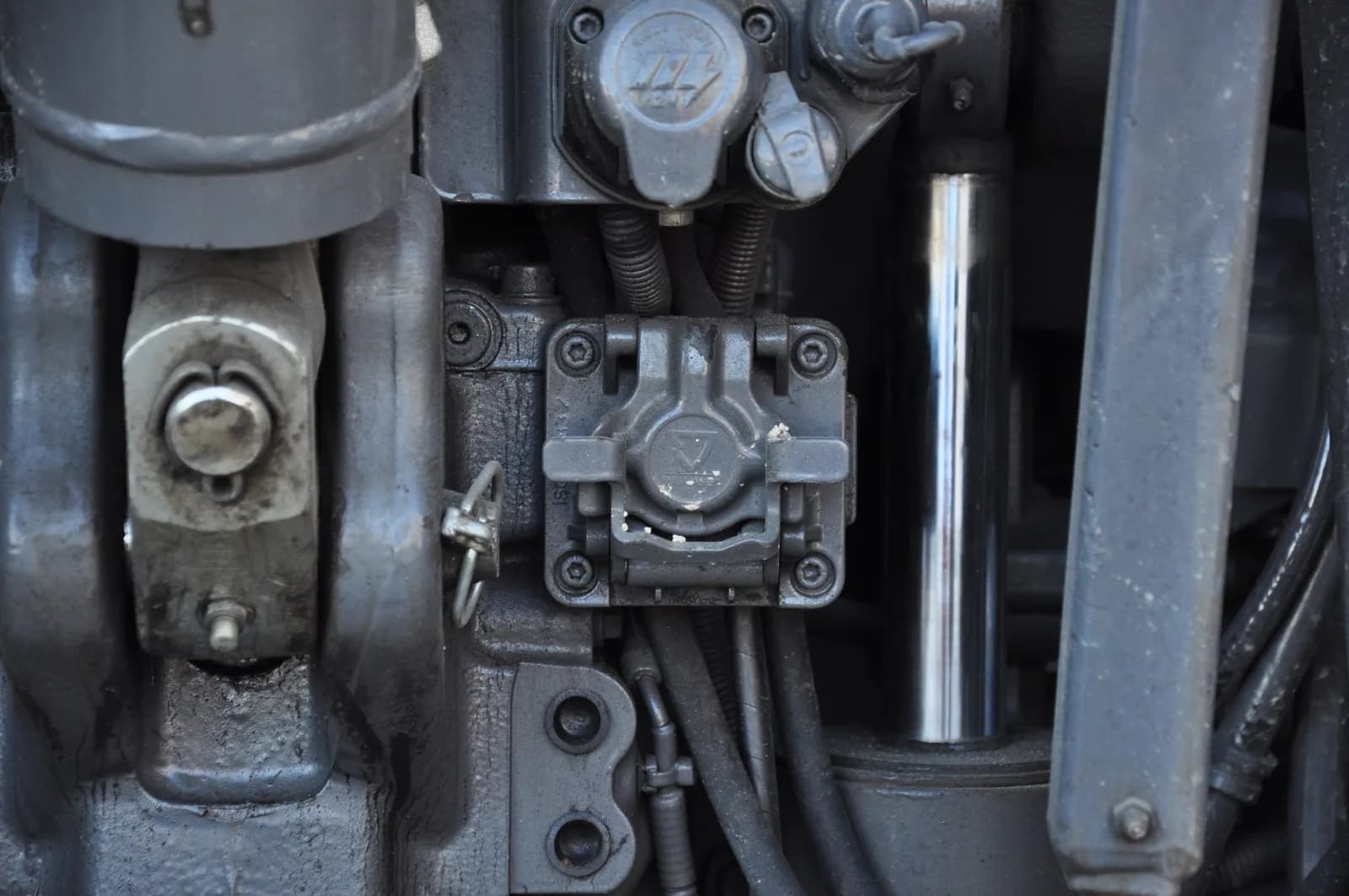
In short: An ISOBUS network is a CAN bus, and a CAN bus needs a terminator at each of its two ends. On ISOBUS the tractor terminates its own end, and the implement end is closed by a terminating bias circuit, or TBC, powered from pins 6 and 7 of the rear socket. With everything switched off, you should read about 60 ohms between CAN H and CAN L. About 120 ohms means one end is missing.
Nobody thinks about the ISOBUS terminator until the implement stops showing up on the screen. It lives inside a plug or harness you never open, and when it is wrong you get "implement not found", a flickering Virtual Terminal, or CAN bus errors that come and go. Below: what it does, where it sits, how to test it, and what the "terminator plug" at your dealer actually is.
What an ISOBUS terminator does
ISOBUS runs on CAN, a two-wire bus (CAN H and CAN L) shared by every control unit on tractor and implement. A signal reflects back when it hits an open end of those wires. The terminator absorbs it. Without one, reflections corrupt the messages and control units start missing each other.
A CAN bus has two ends, so it needs exactly two terminators. On ISOBUS:
- Tractor end: terminated inside the tractor, in its own harness or control unit. You rarely see it.
- Implement end: terminated by a TBC, often built into the implement's plug, powered from the tractor through the rear ISOBUS connector.
Control units in between sit on the bus without termination of their own.
Passive terminator vs active TBC
A plain CAN terminator is passive: a 120 ohm resistor across CAN H and CAN L.
ISO 11783 specifies an active version for the implement bus, the terminating bias circuit (TBC). It is still a termination network across CAN H and CAN L, but it is powered and holds both lines at a defined level. Because the tractor powers it, the bus stays terminated even when an implement control unit is off, unplugged or dead. That is why the connector has its own TBC power pins.
| Passive terminator | Active TBC | |
|---|---|---|
| What it is | Resistor across CAN H and CAN L | Powered termination and bias network |
| Needs power | No | Yes, TBC power and return |
| Typical place | Generic CAN networks, some tractor harnesses | End of the ISOBUS implement bus |
Where the ISOBUS TBC sits on the connector
The TBC pins are part of the 9-pin connectors defined in ISO 11783-2. For the full tables, see the ISOBUS connector pinout guide.
Rear (and front) ISOBUS socket
The external socket, the one your implement plugs into, has three termination pins next to the CAN pair:
| Pin | Function | What it does |
|---|---|---|
| 5 | TBC connect | Bridged inside the implement plug. Never wired to anything else |
| 6 | TBC power | Supply for the terminating bias circuit |
| 7 | TBC return | Return path for the terminating bias circuit |
| 8 | CAN H | Bus high |
| 9 | CAN L | Bus low |
With no implement plugged in, the tractor's bus ends at the socket and the tractor side keeps it terminated. The bridged pin 5 in the implement plug tells the tractor side that the bus now continues into the implement, where the TBC at the far end, fed from pins 6 and 7, becomes the second terminator. A home-made plug that gets pin 5 wrong can give bus faults that look like a faulty implement.
In-cab ISOBUS socket
The in-cab connector has its own layout. It carries TBC power on pin 6 and TBC ground on pin 8, for a device that needs to terminate the bus at that point. The ISOBUS in-cab connector pinout has the full table. The two sockets use different layouts and their plugs do not mate, so always check which table you are reading.
Symptoms of a missing, doubled, or failed terminator
Termination faults rarely say so. They show up as communication problems:
- Implement not found, or it appears on the terminal and then drops out.
- Flickering VT: the implement's screens load, freeze, or reload for no reason.
- Bus error codes that come and go, often SPN 639. The ISOBUS fault codes guide explains how to read them.
| Situation | What goes wrong |
|---|---|
| One terminator missing | Reflections from the open end, intermittent communication errors |
| Two terminators on one end (three total) | Resistance too low, signal levels drop, errors increase |
How to check ISOBUS termination with a multimeter
A five-minute job that rules termination in or out before you start pulling harnesses.
- Switch the tractor off and let the control units shut down. Measure on an unpowered bus.
- Connect the implement as you normally run it.
- Set the multimeter to resistance.
- Measure between CAN H and CAN L. On the rear socket, that is pins 8 and 9. You can also measure at a plug further down the bus.
| Reading | What it usually means |
|---|---|
| About 60 ohms | Two terminators present. Correct |
| About 120 ohms | Only one terminator. One end is open |
| Well under 60 ohms | Too many terminators, or a short between CAN H and CAN L |
| Very high or open | No termination at all, or a broken CAN wire |
Treat these as the CAN rule of thumb. The TBC is an active circuit, so an unpowered reading can land a little off the round numbers. What matters is the comparison with the implement disconnected and connected. If connecting it does not bring the reading towards 60 ohms, look at the implement's end of the bus. The ISOBUS troubleshooting guide has the next steps once termination checks out.
Terminator plugs, dummy plugs and the front socket
Dealers sell several different parts as "terminator plug", "dummy plug" or "bridge plug". Check which one you are buying.
- Terminator plug. Closes the bus at a socket that would otherwise be an open end. It contains the termination network and plugs into the connector like an implement would.
- In-cab bridge plug. On tractors where the in-cab socket sits in the middle of the bus, a bridge plug joins the incoming and outgoing CAN lines when nothing is plugged in. It keeps the bus continuous. It is not a terminator.
- Parking socket or dust cap. Somewhere to hang the implement's plug when it is disconnected, or a cap to keep dirt out. Mechanical only.
The front socket case
A front ISOBUS socket is a second possible bus end. Check the manual or ask the dealer how it is terminated when empty. On some setups that takes a terminator plug, and a missing one gives the rear implement the symptoms above. The 60 ohm check at the rear socket, front socket empty, shows quickly whether the tractor side is in order. Running a front and a rear implement together is covered in two ISOBUS implements at once.
ISOBUS Block and termination
ISOBUS Block plugs into either the in-cab or the external ISOBUS socket, using the connector kits sold with the module. The External Connector Kit is the standard ISO 11783-2 implement connector and terminates onto six pins: ECU ground and ECU power for the module, CAN H and CAN L, and the tractor's fused power supply and chassis ground for the relay COM bus. Pin 5 is the connector's factory-bridged contact, so you do not wire it. The kit does not use TBC power on pins 6 and 7.
On the in-cab socket, the module uses four pins: CAN L on pin 2, CAN H on pin 4, BAT+ on pin 7 and ground on pin 9. The TBC pins 6 and 8 are not used. Full pin diagrams for both are on the docs page.
The module has a termination jumper on the board for the rare setup that needs it. Normally you leave it off: the tractor and the implement already terminate the bus. Whatever you plug in, the check is the same: measure CAN H to CAN L before and after fitting it, and expect the reading to stay near 60 ohms.
Frequently asked questions
Do I need an ISOBUS terminator?
The bus needs one at each end. The tractor terminates its own end, and a standard ISOBUS implement terminates the far end of its bus with a TBC. You only add one yourself when a bus end is left open.
Where is the ISOBUS terminator located?
The tractor-side terminator is inside the tractor's own wiring or control unit. The implement-side TBC sits at the far end of the implement's bus and is powered from pins 6 and 7 of the rear ISOBUS socket. On the in-cab socket, TBC power is on pin 6 and TBC ground on pin 8.
What happens if the ISOBUS bus is not terminated?
Signals reflect off the open end and corrupt messages. The implement is not found, drops off the terminal, or throws CAN errors such as SPN 639. With one terminator missing, CAN H to CAN L reads about 120 ohms instead of 60.
Can I have two terminators on ISOBUS?
You need exactly two, one at each end. A third one, or two at the same end, pulls the reading below 60 ohms and weakens the signal.
What is TBC power on an ISOBUS connector?
It is the supply for the terminating bias circuit, the active terminator at the end of the implement bus. On the rear socket it is pin 6, with the return on pin 7. The tractor supplies it so the bus stays terminated when an implement control unit is off.
Is an ISOBUS dummy plug the same as a terminator?
Not always. The name is used for terminator plugs, in-cab bridge plugs and parking sockets. Only the first closes a bus end. Check the part number before you buy.
Need to switch work lights, solenoids or hydraulic valves from the tractor screen? ISOBUS Block gives you 8 relay outputs controlled from your Virtual Terminal and AUX-N buttons. Pinouts and wiring are on the docs page.