In short: Boom fold, lift and tilt are on/off solenoid jobs, so each direction gets its own relay channel on ISOBUS Block, set to MOM and assigned to an armrest button through AUX-N. Both directions of fold, lift and tilt take six channels. The other two can switch boom work lights and a beacon on TOG. Rate and sections stay on the sprayer's own ISOBUS controller.
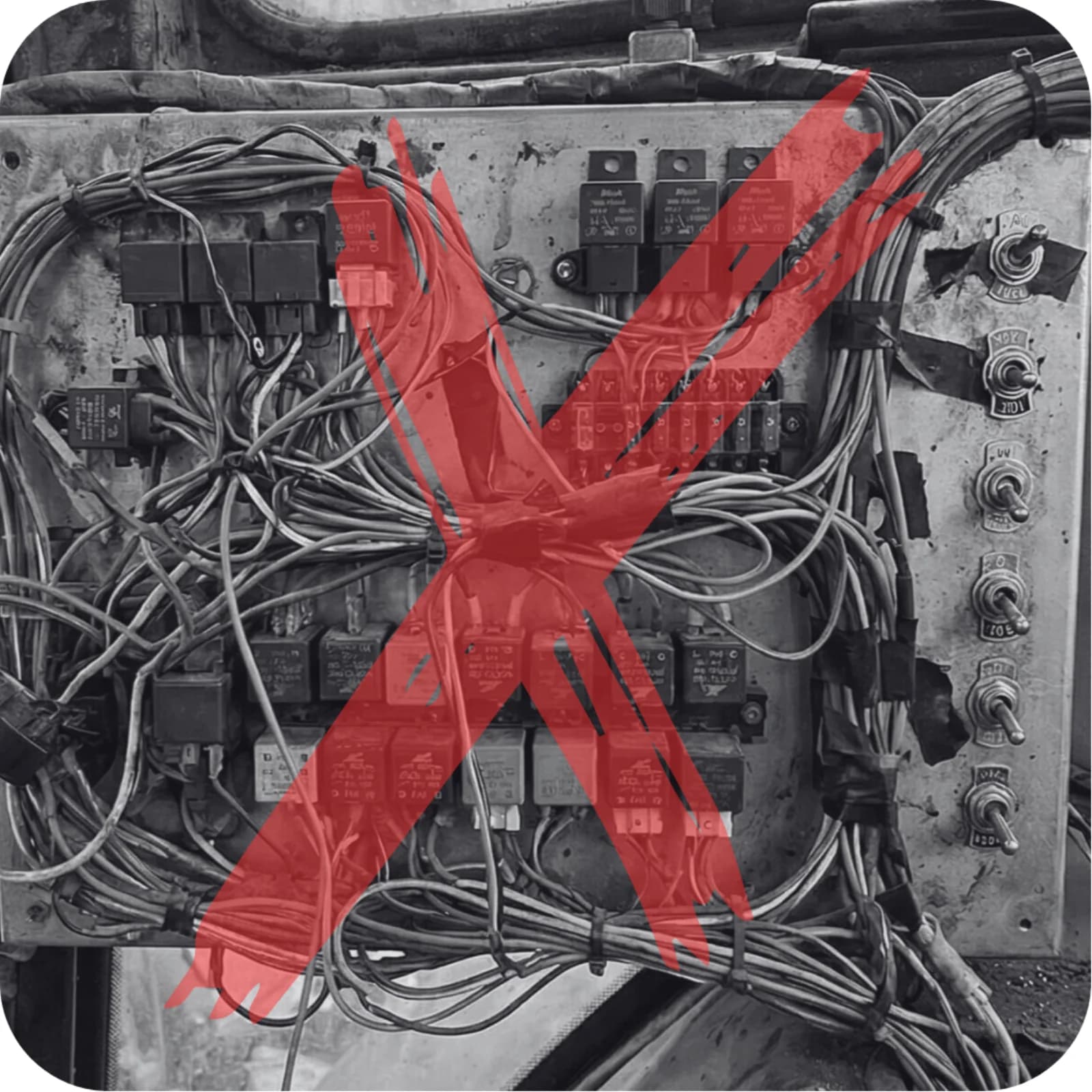
Your sprayer has a full ISOBUS rate controller. Rate, sections, and the actual application run from the sprayer's own screen, and that side works fine. But the boom movements (folding the wings, raising and lowering boom height, tilting for slope) still run from an ugly aftermarket switch box bolted next to the armrest. A panel full of switches, its own loom draped across the cab, never tied into the tractor's own controls.
This post shows how to move those boom movements onto the tractor's armrest buttons with ISOBUS AUX-N. You wire each boom-movement solenoid to a relay channel, map each movement to a button you already have, and the switch box comes out of the cab. The spraying stays exactly where it is: on the sprayer's own ISOBUS system. The Block only touches the boom movements.
Two Systems, Side by Side
This is the part to be clear about, because it is the whole point. After the install you have two separate systems running next to each other:
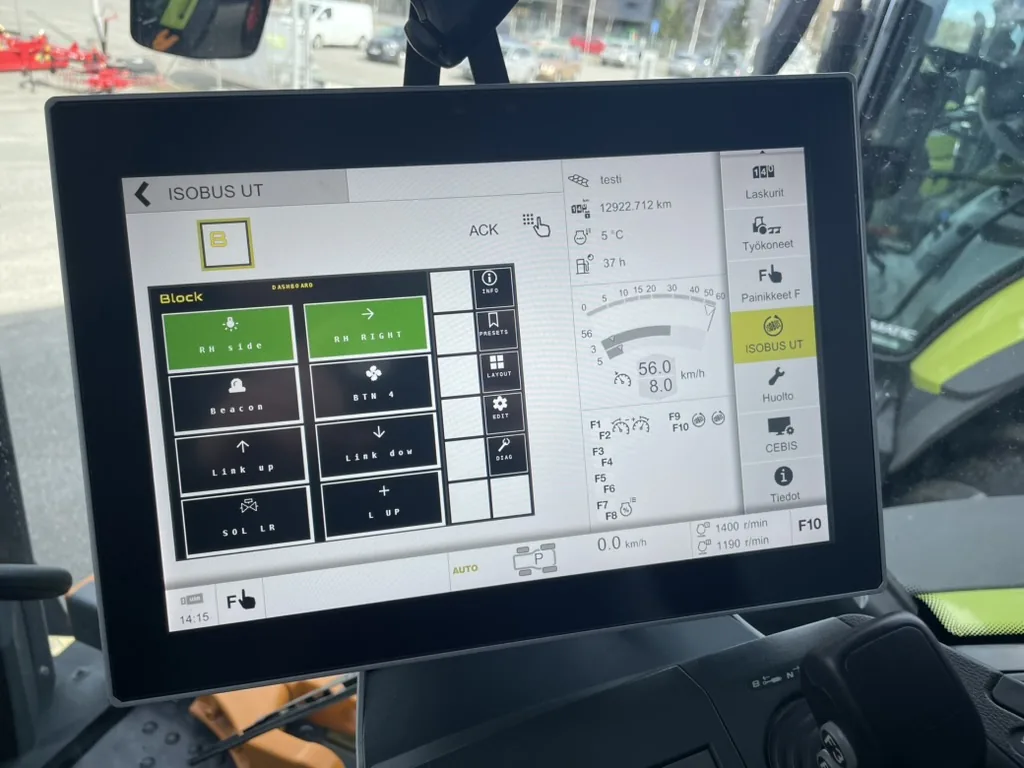
- The sprayer's own ISOBUS system runs the spraying. Rate control, section control, pressure, the application itself. All of that stays on the sprayer's VT and its rate controller. The Block does not touch it.
- ISOBUS Block runs the boom movements. Fold, lift, tilt. Nothing else.
The Block does not see your spray rate. It does not switch sections. It does not touch the spray plumbing or the recirculation line. Those belong to the sprayer's own controller, and they stay there. The Block replaces one thing only: the switch box that drove the boom's hydraulic movements.
Why a Relay Module Is the Right Tool for Boom Movements
Boom movements are on/off jobs. Fold the wing out, fold it in. Raise the boom, lower it. Tilt left, tilt right. Each direction is a simple ON/OFF solenoid valve. There is no proportional or variable control involved: the wing folds while the valve is open and stops when it closes.
ISOBUS Block is an on/off relay module. Eight channels, CH1 through CH8, each switching a circuit on or off. That maps onto boom movements exactly. One solenoid, one relay channel, one button.
It is worth being honest about where a relay module is the wrong tool. A function that needed a variable signal (a proportional valve metering flow to a set percentage, say) is not something a simple ON/OFF relay can do. But boom fold, lift, and tilt are not that. They are on/off solenoids, and an on/off relay is exactly what they want. For the wider picture of how relays, solenoids, and ISOBUS fit together, see the ISOBUS implement control guide.
What Actually Gets Wired
Each boom-movement solenoid is switched by an electrical coil. The Block switches that coil. It does not touch the cylinders, the valves, the hoses, or the boom structure. The control chain is:
Button press, relay switches, solenoid energises, valve opens, boom moves.
Everything downstream of the solenoid (the valve, the hydraulic oil, the cylinder, the boom wing) stays exactly as the sprayer maker built it. You are replacing the control wiring that ran to the switch box, not the hydraulics. This is the same swap covered in replacing an implement joystick with AUX-N: pull the separate control, keep the machine.
Each relay channel has NO, COM, and NC terminals. You run the solenoid's lead through the relay so that energising the channel completes the circuit to the coil. Load power comes from a 12/24V source you supply; the ISOBUS connection powers the module, not the loads. Each channel switches up to 10 A, which covers ordinary boom-movement solenoid coils with room to spare.
An Example 8-Channel Layout
Each movement direction is its own on/off solenoid, so it gets its own channel. The exact count depends on your boom, but here is a representative layout for an 8-channel module:
| Channel | Boom movement | Mode |
|---|---|---|
CH1 | Fold out (wings) | MOM |
CH2 | Fold in (wings) | MOM |
CH3 | Lift up (boom height) | MOM |
CH4 | Lift down (boom height) | MOM |
CH5 | Tilt left (slope/level) | MOM |
CH6 | Tilt right (slope/level) | MOM |
CH7 | Boom work lights | TOG |
CH8 | Beacon | TOG |
That covers the three boom movements in both directions, with two channels left for work lights and a beacon. If your boom has fewer movements, you have more spare channels. If it has more, you assign the ones you use most.
Momentary or Toggle
You set each channel's mode from the Virtual Terminal:
MOM(momentary): the relay is active only while you hold the button. The wing moves while you hold, stops when you release. This is the natural choice for boom movements, because you watch a large structure move and stop it at any point.TOG(toggle): press once on, press again off. This suits a set-and-hold state like the boom work lights or a beacon.
Boom fold, lift, and tilt are momentary work. Hold to run, release to stop. Set-and-leave outputs run as toggle. Each channel is independent, set per button on the VT.
Mapping the Movements to the Armrest
This is where AUX-N comes in. AUX-N (Auxiliary Input Type N, part of ISO 11783) lets you bind a function to a physical button on the tractor: a joystick trigger, an armrest switch, a rocker. The Block publishes a function per relay channel to the tractor's AUX-N menu, and you assign each one to the button you want.
Name the channels first, on the tractor screen, and the assignment menu reads properly. Rename CH1 to FOLD OUT, give it a sensible icon, and the AUX-N menu shows FOLD OUT, not a bare channel number. The ISOBUS AUX-N complete guide walks through the assignment process and where the menu lives on each tractor brand.
You can also drive every channel straight from the VT screen, where the Block shows up as a tile grid. Most operators use both: the screen for setup and the odd rarely-used function, the armrest buttons for the daily fold and lift on the headland. The screen and the buttons switch the same relays. For more on running outputs from the screen you already have, see control any device from your ISOBUS terminal.
Where the Module Mounts
The boom solenoids are out on the sprayer, not in the cab, so mounting the module on the implement is the natural fit: a sealed enclosure bolted to the sprayer frame, with a cable running to the tractor's rear external ISOBUS connector. The Block rides on the implement, close to the solenoids it switches. The enclosure is yours to supply. The module's own housing is IP20, so it needs an IP65 box out on the frame.
A cab-mounted module is also possible, using the in-cab ISOBUS connector and running cab wiring out to the loads. That is the installer's call, sized to how the sprayer is laid out. Either way the control logic is identical: the relays switch, the solenoids follow, and the boom moves. For what retrofitting a sprayer with ISOBUS control costs and involves, see the ISOBUS retrofit guide.
Will This Work With My Tractor and Sprayer?
The Block's AUX-N functions are its own, independent of the sprayer, so the question splits in two.
The sprayer. It stays exactly as it is. Its ISOBUS rate controller keeps running rate and sections on its own screen. You are not touching the spraying side at all. The only requirement is physical access to the boom-movement solenoid wiring, which is the loom that currently runs to the switch box.
The tractor. It needs AUX-N support, since that is the layer doing the button assignment. Most tractors with a full ISOBUS armrest from around 2012–2015 onward support AUX-N. Check the ISOBUS compatibility guide to confirm where your tractor stands. Because the Block registers as its own device on the bus, the tractor treats its boom-movement functions like any other implement's, regardless of what the sprayer does.
Frequently Asked Questions
Can I control my sprayer's boom from the tractor armrest?
Yes. Wire each boom-movement solenoid (fold, lift, tilt) to a relay channel on an ISOBUS module and assign each function to a tractor armrest or joystick button over AUX-N. The boom movements then run from the tractor's own controls. The sprayer's rate controller keeps running the spraying separately on its own screen.
How do I replace a sprayer's boom switch box?
Wire the boom-movement solenoids that the switch box drove to a relay module's channels instead, then map each movement to an armrest button over AUX-N. The switch box and its loom come out of the cab. The relay module switches the same solenoid coils; the hydraulics stay exactly as they are.
Do boom movements need proportional control?
No. Boom fold, lift, and tilt are on/off jobs: the wing moves while the solenoid valve is open and stops when it closes. A simple ON/OFF relay handles them. Proportional control is only needed for functions that meter flow to a variable setting, which boom movements do not.
Does adding a relay module interfere with my sprayer's rate controller?
No. The relay module registers as its own device on the ISOBUS bus and handles only the boom movements you wire to it. The sprayer's rate controller keeps running rate, sections, and pressure from its own interface. The two systems run side by side; the module never touches the spraying.
Does the relay module replace my sprayer's boom hydraulics?
No. It switches the control side only: the solenoid coil on each boom-movement valve. The valves, cylinders, hoses, and the boom structure stay exactly as the sprayer maker built them. The chain is: button press, relay switches, solenoid energises, valve opens, boom moves.
Need an ISOBUS relay module for controlling solenoids, work lights, or hydraulic valves? ISOBUS Block provides 8 relay outputs controlled directly from your tractor's Virtual Terminal display and armrest buttons.