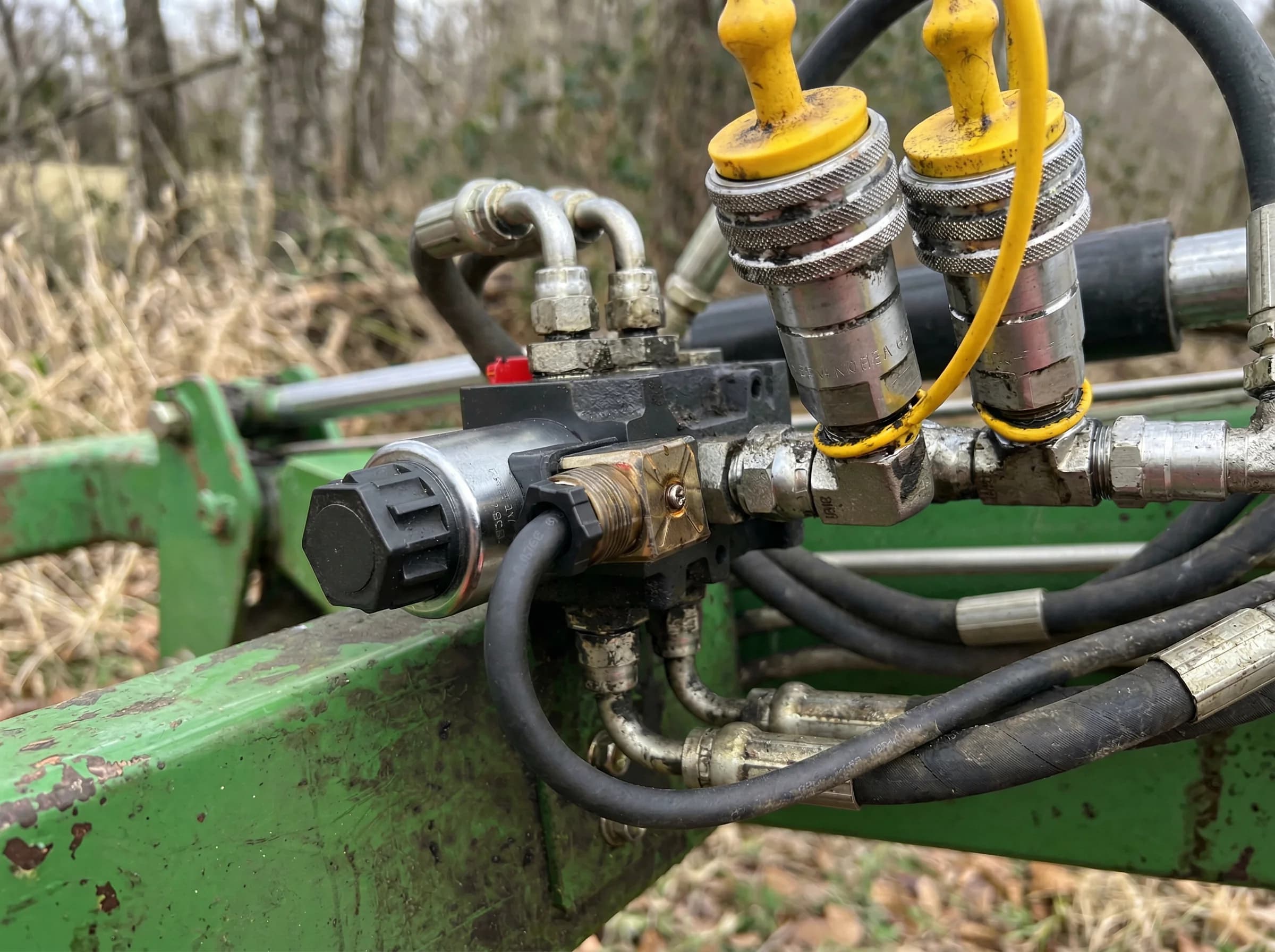
In short: To run several hydraulic functions from one spool valve, fit an electric selector valve on the implement and switch its coils with ISOBUS Block from the tractor screen or an AUX-N joystick button. Each coil goes on one relay channel. Functions on the same spool valve move one at a time, and the spool valve still supplies the oil and sets the direction.
Your plough has more double-acting hydraulic functions than the tractor has spool valves to spare. The fix is an electric selector valve on the implement: one pair of hoses from one spool valve, and a coil on the selector decides which cylinder gets the oil. On an ISOBUS tractor, you pick that function from the tractor screen or a joystick button, not from a switch box or a pull-cable.
Here is the plan step by step, with a reversible plough as the example. The parts for this job: Electric diverter valve control from the tractor screen.
More hydraulic functions than spool valves: what a selector does
A spool valve is the tractor's own hydraulic control valve, with its pair of couplers at the rear. It drives one double-acting function at a time. A selector valve (also called a diverter valve) sits on the implement between those couplers and several cylinders. It adds no oil flow. It only decides where the oil goes.
The classic ways to switch it are a pull-cable to a mechanical selector, or a toggle box in the cab with a cable out through the back window. On a new tractor, the armrest has no spare spot for a switch, and nobody wants to tap into the tractor's wiring for a switched feed.
An electric selector needs a switched 12 V or 24 V feed to each coil.
On an ISOBUS tractor, ISOBUS Block switches the coils of a selector valve on the implement from buttons the tractor already has, so one spool valve runs several hydraulic functions with no switch box in the cab. Each coil goes on one relay channel. You pick the function from an AUX-N button on the armrest or joystick. If your terminal has no AUX-N, the same buttons work from the tractor screen.
ISOBUS Block runs on any ISOBUS tractor terminal and has been manually tested on all major brands, with customers running it daily on Fendt, Valtra, John Deere, Case IH, CLAAS, New Holland and Massey Ferguson tractors and on the AmaTron 4 from Amazone, Jaltest and Arag add-on terminals.
| Part | Who controls it |
|---|---|
| Oil flow and direction | The tractor's spool valve, as today |
| Which function gets the oil | The selector valve coils |
| Which coil is energised | A relay channel, switched from the screen or an AUX-N button |
The hoses stay as they are: rubber hoses with steel fittings from the selector to each cylinder. Only the control side changes.
Step 1: List the functions and how often you use them
Write down every double-acting function on the implement and how often you move it. Take a hypothetical reversible plough with four:
| Function | How often you move it |
|---|---|
| Turnover | Every headland |
| Working width | A few times per field |
| Front furrow width | When you set up |
| Depth wheel | When you set up |
Your plough's list will differ. The frequency decides which function gets the selector's default position.
Then check each pair: do these two ever need to move at the same time? Functions that share one spool valve move one at a time. If two cylinders must move together, they need separate spool valves.
Step 2: Choose the selector layout
Electric selectors come in two common layouts. The valve's hydraulic diagram shows which coils must be energised for each function. That table is your channel plan.
One coil per function
A valve block with a coil for each function it switches. Some blocks also send the oil to one function when every coil is off. If yours does, put the function you use most on that no-coil path. In the plough example that is turnover: at the headland you only move the spool valve. If no coil means no function, every function needs its own coil and button. The snow plough wing control guide shows this layout with one coil per wing.
Selector valves in a cascade
Two-position selectors, such as the 6/2 diverter used for a front loader third function, can be chained. Coil off, the first valve feeds function 1. Coil on, it passes the oil to the next valve. A function deeper in the chain needs every coil in front of it energised too. One button can switch several channels, so each function still gets one button.
Valve types and coil counts are covered in switching hydraulic solenoid valves from the ISOBUS terminal.
Step 3: Plan the channels
The rule: one relay channel per coil. ISOBUS Block has eight, CH1 to CH8, and each switches up to 10 A, more than a selector coil draws.
For the plough with a one-coil-per-function block and turnover on the no-coil path:
| Function | Coil | Channel | Button name | Mode |
|---|---|---|---|---|
| Turnover | None (default path) | None | None | None |
| Working width | Coil 1 | CH1 | WIDTH | TOG |
| Front furrow width | Coil 2 | CH2 | FURROW | TOG |
| Depth wheel | Coil 3 | CH3 | WHEEL | TOG |
| Free | CH4 to CH8 |
Three channels for four functions, and five left for work lights, a beacon or a second selector.
Which coils must never be on together
Two coils on at once connect two cylinders to the same oil. The oil goes wherever moving is easiest, which may not be the cylinder you meant. Switch one function off before you select the next. The lit tile on the tractor screen shows which one is selected.
Step 4: Wire the coils
The module can sit in two places:
- On the plough, in a weatherproof enclosure, plugged into the tractor's rear external ISOBUS socket. That socket powers the module and carries a battery feed for the loads, fused by the tractor at 60 A. No tapping into the tractor's wiring. The bare module is IP20, so outside the cab it needs the enclosure.
- In the cab, on the in-cab ISOBUS socket. The module gets its power there, but the coils need their own +12 V or +24 V feed, such as the battery, and a lead back to the plough.
Each coil wires the same way: supply positive to COM, NO to the coil, the coil's other side to ground.
Channel on, coil energised. Channel off, a spring-return selector goes back to its rest position. So if the module loses power, the oil goes to the default path. One more reason to choose that function with care.
Match the coil voltage to the tractor. Coil current, fuses and diodes are in the solenoid valve wiring guide. The tractor sockets guide shows which socket carries what. Both ISOBUS pinouts and the connector kits are on the docs page.
Step 5: Assign the buttons
On the tractor screen, press EDIT. The buttons turn blue. Tap one, then set:
- NAME:
WIDTH, up to 8 characters. - ICON: a valve or cylinder icon.
- OUTPUTS: the channel or channels for that function.
- MODE:
TOGorMOM.
TOG suits most selectors: press once to select, press again to drop back to the default. MOM keeps the coil on only while you hold the button. Use it if you would rather hold a button than remember to switch it off.
Then open the tractor's AUX-N menu and put WIDTH, FURROW and WHEEL on free joystick or armrest buttons. AUX-N is the part of ISOBUS that puts implement functions on the tractor's own buttons, and the menu shows the names you typed. The AUX-N complete guide covers the menus. Without AUX-N, the tiles on the screen do the same job.
Step 6: Working in the field
Select first, then move the oil:
- Spool valve in neutral.
- Press the button for the function. Its tile lights up.
- Move the spool valve as usual. The selected cylinder moves.
- Spool valve back to neutral.
- Press the button again to drop back to the default.
The tractor's flow setting for that spool valve applies to whichever function is selected. At the headland, with turnover on the default path, the plough turns over the way it always has.
Removing a whole switch box rather than adding a selector? See replacing the cab switch box with AUX-N.
Setup, support and delivery
- Setup: 5 to 10 minutes on the tractor terminal, naming the buttons and picking their icons. Nothing to install on a computer.
- First use: the same day the module arrives.
- Support: on WhatsApp and by email, answered by the people who design and build the module. On WhatsApp a reply typically comes within minutes during the working day. Every message gets an answer within one business day.
- Warranty: 5 years.
- Shipping: free express shipping. Orders ship the next business day.
Frequently asked questions
What is the easiest way to switch a selector valve without a switch box in the cab?
On an ISOBUS tractor, wire the selector valve coils to the relay channels of ISOBUS Block. You select each function from a joystick or armrest button through AUX-N, or from the tractor screen. The hoses and the spool valve stay as they are.
How do I run more hydraulic functions than my tractor has spool valves?
Fit an electric selector (diverter) valve on the implement and switch its coils with ISOBUS Block from the tractor screen or joystick. One spool valve feeds the selector, and the selector's coils decide which cylinder gets the oil. Functions on the same spool valve move one at a time.
Can a plough run several hydraulic functions from one spool valve?
Yes, through a selector valve on the plough, with ISOBUS Block switching its coils. Put the headland function on the default path, if the selector has one, and select the others with a button first.
How many relay channels does a selector valve need?
One channel per coil. In a cascade of two-position valves, a deeper function switches several channels from one button.
Can I select the diverter valve from the tractor joystick?
Yes, on an ISOBUS tractor with AUX-N. Wire the selector coil to a relay channel on ISOBUS Block, name the button on the screen, and assign it to a joystick or armrest button in the AUX-N menu.
Can two functions on one selector valve move at the same time?
Not under control. Select one function at a time. Functions that must move together need separate spool valves.
What if I get stuck during the install?
Message ISOBUS Block support on WhatsApp or by email. The people who design and build the module answer, and on WhatsApp a reply typically comes within minutes during the working day. A photo of the wiring or the screen with your question is enough to start. If your terminal ever does not show the module, we sort it out with you.
Need to switch selector valve coils from the tractor screen and joystick? ISOBUS Block gives you 8 relay outputs, controlled from your tractor's Virtual Terminal and AUX-N buttons.