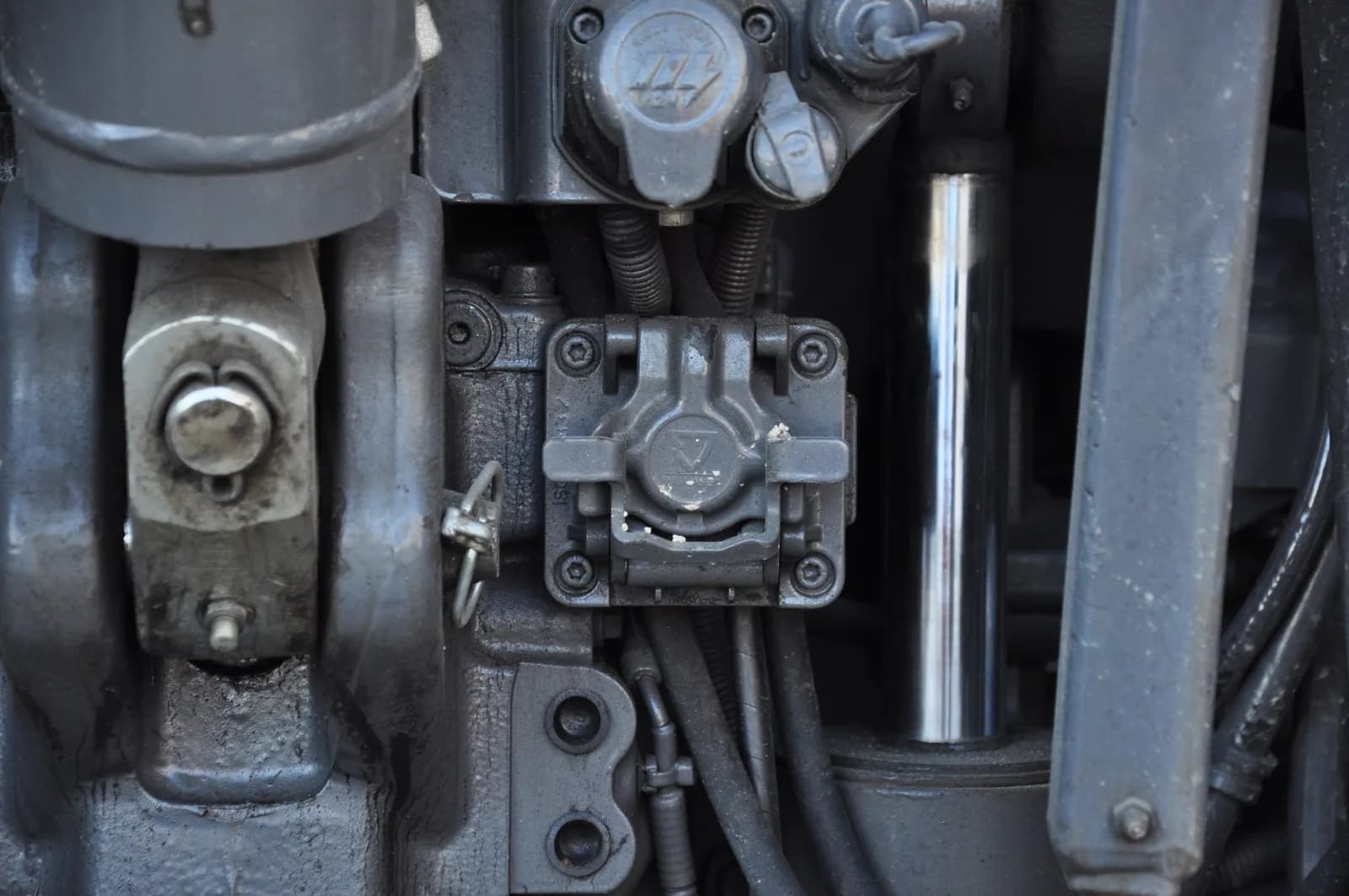
In short: A modern tractor carries up to five kinds of socket. The 3-pin socket supplies power. The 7-pin lighting socket runs road lights on a trailer or implement. The 7-pin signal socket (ISO 11786) sends speed, PTO and hitch position to non-ISOBUS controllers. The 9-pin ISOBUS sockets, one outside and one in the cab, carry power, data and the implement's screen in one plug.
Tractor sockets look alike from the seat, and the manual rarely shows them side by side. Below: what each one carries, how to spot it, and which socket a given job needs.
The 3-pin power socket (DIN 9680)
The 3-pin socket is the tractor's general-purpose power outlet for implements. It is standardised as DIN 9680. You find one in the cab and often another at the rear.
| Pin | What it carries |
|---|---|
| Large pin | Battery positive, permanent |
| Large pin | Ground |
| Small pin | Ignition-switched positive |
The socket is rated for 25 A, 12 V on most tractors. Enough for a control box, a hectare counter or a set of work lights. The classic cab switch box ran from it: power in through the 3-pin plug, a toggle per function, a multi-core cable out through the back window. A typical front loader third function kit takes its power from it too. Put anything that must not drain the battery overnight on the ignition-switched pin.
The older 4-pin and 5-pin implement plugs
Some older machines carry a 4-pin implement power plug instead of, or next to, the 3-pin socket. Newer tractors have moved to the 3-pin socket for power and ISOBUS for the rest, so you mostly meet it on second-hand equipment. 5-pin plugs turn up too. Layouts for both vary between makers and are poorly documented, so we do not publish pin tables. Check the manual and measure before connecting anything.
The 7-pin lighting socket (ISO 1724)
The 7-pin lighting socket runs the road lights on a trailer or implement: indicators, tail lights, brake lights and rear fog light. It is the 12 V socket defined in ISO 1724, the same 7-pin standard long used for car trailers.
| Pin | Signal |
|---|---|
| 1 | Left indicator |
| 2 | Rear fog light |
| 3 | Ground |
| 4 | Right indicator |
| 5 | Right tail light |
| 6 | Brake lights |
| 7 | Left tail light |
This socket is for road lighting only. It is not an implement power supply, and it carries no data.
The 7-pin signal socket (ISO 11786)
The signal socket is a second 7-pin socket, and it has nothing to do with lights. It sends the tractor's own measurements to an implement controller that cannot read them over ISOBUS. It was standardised before ISOBUS became common, as DIN 9684 part 1 and later as ISO 11786.
It carries:
- Wheel speed, the theoretical speed from the transmission or wheel sensor
- Ground speed, the true speed from a radar sensor, where the tractor has one
- PTO speed
- Hitch position, telling the controller whether the rear linkage is in work or lifted
- Power and ground for the signal side
Non-ISOBUS sprayer and spreader controllers use it to hold a rate against speed. Stand-alone hectare counters use speed and hitch position to count only the area worked. Check the tractor manual for pin numbers before wiring to a specific pin. An ISOBUS implement usually does not need this socket: a tractor ECU can send the same values over the ISOBUS connection.
The 9-pin ISOBUS sockets (ISO 11783-2)
ISOBUS uses two 9-pin connectors, both defined in ISO 11783-2. They look similar in a photo but do not mate with each other.
Rear external ISOBUS connector
The rear external ISOBUS connector is the large round socket on the back of the tractor, near the hydraulic couplers. Some tractors have a matching one at the front. It has a bayonet collar and is designed to pull apart cleanly if an implement comes off the hitch.
It carries four things:
- CAN bus, the data link to the implement's control unit
- ECU power, to run the implement's electronics
- Load power, a battery supply the tractor fuses at 60 A for the implement's solenoid valves, motors and lights
- Terminating bias circuit (TBC) supply, which powers the terminator at the implement end of the bus
In-cab ISOBUS connector
The in-cab ISOBUS connector is a smaller round 9-pin socket inside the cab, usually to the right of the seat or on the B-pillar. It is where terminals, diagnostic tools and cab-mounted modules plug into the network. It carries two CAN buses, ECU power and a TBC supply, but not the 60 A load supply.
Pin-by-pin tables for both are in the ISOBUS connector pinout guide, with a quick reference for the cab socket in the in-cab connector pinout.
What goes where
| Socket | Pins | Carries | Plugs into it |
|---|---|---|---|
| 3-pin power (DIN 9680) | 3 | 12 V power, permanent and ignition-switched, 25 A | Control boxes, counters, work lights, small motors |
| 7-pin lighting (ISO 1724) | 7 | Road lighting circuits | Trailer and implement road lights |
| 7-pin signal (ISO 11786) | 7 | Wheel speed, ground speed, PTO speed, hitch position | Non-ISOBUS controllers, hectare counters |
| Rear external ISOBUS (ISO 11783-2) | 9 | CAN, ECU power, 60 A load power, TBC | ISOBUS implements, implement-mounted modules |
| In-cab ISOBUS (ISO 11783-2) | 9 | Two CAN buses, ECU power, TBC | Terminals, diagnostics, cab-mounted modules |
How to tell tractor sockets apart at a glance
Four checks, in this order:
- Count the pins. Three pins is power. Nine pins is ISOBUS. Seven pins is either lighting or signal, so keep going.
- Look at the size. The rear ISOBUS socket is the biggest and heaviest of the lot, built for thick power conductors. The 3-pin socket is chunky too. The in-cab ISOBUS socket is noticeably smaller than the rear one.
- Look at where it sits. Lighting sockets sit at the rear, near the hitch. The in-cab ISOBUS socket and a 3-pin socket are in the cab. A signal socket is usually at the rear, sometimes in the cab.
- Read the cap. Cap colours vary between makers, so do not rely on them. Many caps carry a label or symbol, and the manual's socket diagram settles it.
To check whether a tractor has ISOBUS at all, and what its terminal supports, see how to tell if your tractor has ISOBUS.
Which socket do I need for what
- Road lights on a trailer or implement: the 7-pin lighting socket.
- Work lights on an implement: power from the 3-pin socket through a switch, or from a relay channel you switch from the cab. The work lights installation guide shows the relay route.
- An old hectare counter: the signal socket for speed and hitch position, plus 3-pin power if the counter needs it. Many tractors also have a worked-area counter of their own. Triggering the tractor's own counter can replace the separate box.
- A non-ISOBUS sprayer controller: the 3-pin socket for power and the signal socket for speed.
- An ISOBUS sprayer, baler or spreader: the rear external ISOBUS connector. One plug, nothing else.
- An add-on relay module: the ISOBUS socket, in the cab or at the rear, depending on where the module lives. Pick the plug with the ISOBUS connector guide.
One cable instead of a bundle through the back window
A non-ISOBUS implement can need a 3-pin plug for power, a signal cable for speed, a lighting plug and a multi-core cable to a switch box on the pillar. Four cables, several of them through the back window.
The ISOBUS connector replaces most of that. One plug carries power for the electronics, power for the loads, the data link and the implement's screen. The controls appear on the terminal you already have, and the functions go on your joystick buttons through AUX-N. The road lights still use their own 7-pin socket.
That is how ISOBUS Block connects. The module takes its power and CAN from the ISOBUS socket, in the cab or at the rear, and gives you 8 relay channels, CH1 to CH8, at 10 A each. You switch them from the tractor screen or an AUX-N button, as TOG or MOM. On the rear socket, the relay supply comes from the tractor's 60 A fused feed on the same connector. In the cab, you feed the relays from a +12 V or +24 V source such as the battery. If you are replacing an old toggle panel, the cab switch box replacement guide walks through it.
Frequently asked questions
What is the 3-pin socket on a tractor for?
It is the tractor's power outlet for implements and cab equipment, standardised as DIN 9680. It has a permanent battery positive, a ground and an ignition-switched positive, rated at 25 A. Control boxes, hectare counters and work lights often run from it.
What is the 7-pin signal socket on a tractor?
It is a socket defined in ISO 11786 that sends wheel speed, radar ground speed, PTO speed and hitch position to an implement controller. Non-ISOBUS sprayer and spreader controllers and stand-alone hectare counters use it. It is not a lighting socket, even though it also has 7 pins.
Can I power an implement from the ISOBUS socket?
Yes. The rear external ISOBUS connector carries ECU power for the implement's electronics and a separate battery supply the tractor fuses at 60 A for its loads. The in-cab ISOBUS connector has no 60 A load supply, so loads switched in the cab need their own feed, such as the battery.
Is the ISOBUS socket the same as the 7-pin trailer socket?
No. The ISOBUS socket has 9 pins and carries CAN data and power. The 7-pin trailer socket carries road lighting circuits only. They are different shapes and do not fit each other.
How do I know which socket my tractor has?
Count the pins, then check the position and the cap label. Three pins is power, nine is ISOBUS, and seven is either lighting or signal. The socket diagram in the operator manual confirms which is which on your model.
Need an ISOBUS relay module for controlling solenoids, work lights, or hydraulic valves? ISOBUS Block provides 8 relay outputs controlled directly from your tractor's Virtual Terminal display.