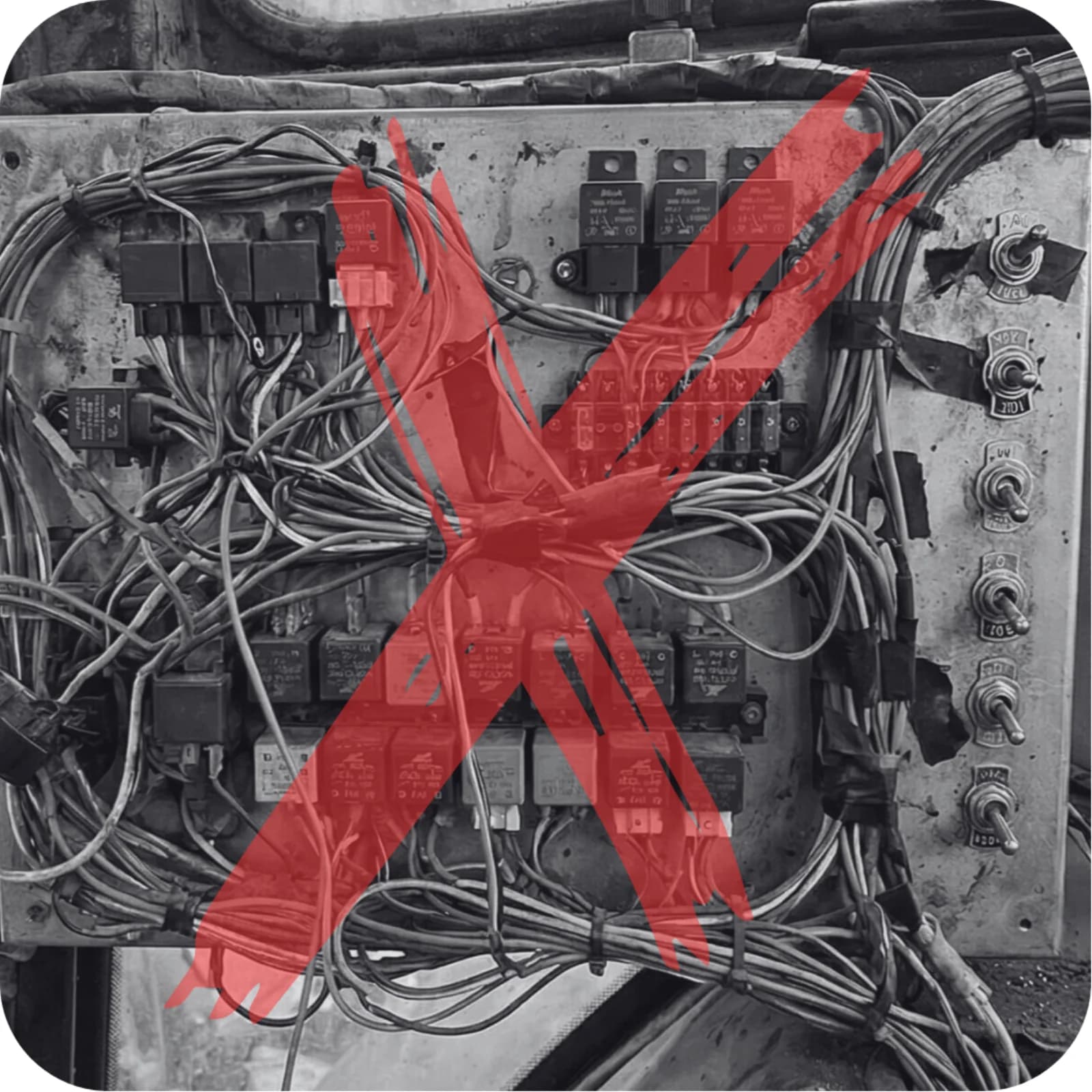
Is ISOBUS worth it on a small farm with two tractors and a shed of mixed implements? Sometimes yes, sometimes no, and the dealer brochure will not tell you which. ISOBUS is the standard that lets an implement use the tractor's plug, screen and joystick instead of bringing its own control box. On a big arable operation the case makes itself. On a small mixed farm it depends on what you already own and what you plan to buy.
Below: what ISOBUS gives you, where the costs sit, when to leave it alone, and a checklist to decide.
What ISOBUS gives you on a small mixed farm
Forget yield maps for a moment. The everyday gains are simpler.
- One screen for every implement. An ISOBUS implement uploads its controls to the tractor's terminal. Unhitch the mower, hitch the spreader, and the screen changes to match. No second display on a suction cup.
- Implement functions on the joystick. With AUX-N, you assign implement functions to the tractor's own joystick and armrest buttons. Fold, open, switch, without reaching for a box on the cab pillar.
- No more cables through the back window. Every non-ISOBUS implement brings its own control box and its own lead into the cab. Two or three of those and the cab looks like the photo at the top of this page.
- Second-hand implements that just plug in. An ISOBUS implement connects to any ISOBUS tractor through the same 9-pin socket, whatever the brand. That widens the used market when you are buying a sprayer or a drill from a neighbour who runs a different colour.
The ISOBUS vs non-ISOBUS implements post goes through the differences side by side.
Where the costs sit
Figures vary too much by brand and dealer to quote. The cost points are always the same three.
| Piece | Either you have it, or you need this |
|---|---|
| Tractor | ISOBUS from the factory (socket plus terminal), or a retrofit terminal and wiring |
| Implement | An ISOBUS ECU fitted, or the implement stays on its own control box |
| Task Controller | Often a paid unlock on the terminal, on top of the basic screen function |
The tractor. Many mid-range and larger tractors built from around 2010 onward came with the rear ISOBUS socket and a terminal. Smaller and utility tractors often did not, or had it as an option. If yours has no terminal, a retrofit terminal is the route, and that is the biggest single cost on this list.
The implement. An implement is ISOBUS only if it carries its own ECU, the control unit that talks to the tractor. A simple topper or tipping trailer has none. Some manufacturers sell an ISOBUS upgrade. Many do not.
The Task Controller. Documentation (TC-BAS), map-based work (TC-GEO) and automatic section control (TC-SC) are often licences you buy separately for the terminal. The Task Controller guide explains what each one does. You do not need any of them to run an implement from the screen.
When ISOBUS is not worth it
Do not spend money chasing it if most of these are true:
- One tractor, one or two simple implements, and they already work.
- The implements have no electronics beyond a couple of switches.
- No plan to change machines in the next few years.
- No need to record what went where, for yourself, a buyer or an inspection.
A two-switch control box that has worked for fifteen years is not a problem that needs a standard to solve it.
When ISOBUS is worth it
The case gets stronger with each of these:
- You already paid for the socket and never used it. More on this below.
- You buy second-hand implements. ISOBUS on the implement means brand does not matter at the tractor end.
- You run a contractor's mixed fleet. Different tractors, implements and operators. One plug and one screen convention saves time at every hitch-up.
- You want the implement on the joystick. On long days with a loader, mower or spreader, this is the gain you feel most.
The socket you already own
If your tractor came from the factory in the last decade or so, check the back of it. There is a good chance a round 9-pin ISOBUS socket sits near the hitch under a cap, and a terminal in the cab has an ISOBUS or UT page nobody ever opened.
That is money already spent. The question becomes: what can I put on the screen I already have? The ISOBUS compatibility guide shows how to confirm what your tractor has, including whether it supports AUX-N button assignment.
What you can add yourself to a non-ISOBUS implement
Most small-farm implements will never get an ECU. Their electrical functions are switched loads: a work light, a beacon, a solenoid valve, a diverter valve on a loader. Those you can bring onto the tractor's screen yourself with a relay module that speaks ISOBUS.
ISOBUS Block is one such module. It has 8 relay channels, CH1 to CH8, each rated at 10 A. It plugs into the tractor's in-cab or rear ISOBUS socket, shows its buttons on the tractor's terminal, and each channel can be assigned to a joystick or armrest button through AUX-N. You name each button and set it to TOG (toggle) or MOM (momentary) from the tractor screen. Wire the diverter valve to CH3, call it DIVERTER, put it on a joystick button. Done.
What it does not do: it does not make the implement an ISOBUS implement in the Task Controller sense. It speaks VT and AUX-N only. No documentation, no section control, no map-driven switching. For switched functions that is all you need. The retrofit guide walks through a full install, and replacing a cab switch box with AUX-N covers the most common small-farm case. If you want the other routes laid out fairly, including just keeping the switch box, see ISOBUS Block alternatives.
A short decision checklist
The more yes answers, the more ISOBUS pays its way.
| Question | Yes means |
|---|---|
| Does the tractor already have an ISOBUS socket and terminal? | The expensive part is already paid for |
| Does it support AUX-N? | Implement functions can go on the joystick |
| Do you plan to buy implements, new or used, in the next few years? | Buy ISOBUS ones and they plug straight in |
| Do several tractors or operators share the same implements? | One standard saves time at every hitch-up |
| Do you have control boxes or switch panels cluttering the cab? | Switched loads can move to the screen |
| Do you need records of work done? | Budget for a Task Controller licence |
Mostly no, and the current setup works? Keep it. Mostly yes? Start with what the tractor already has.
Frequently asked questions
Is ISOBUS worth it for a small farm?
It is worth it if your tractor already has ISOBUS, if you buy implements second-hand, or if you want implement functions on the joystick. It is not worth chasing for one tractor and a couple of simple implements that already work.
Do I need ISOBUS?
Not to farm. Implements with their own control boxes have worked for decades and still do. You need ISOBUS when an implement you want only comes with it, or when you want one screen and joystick control across several machines.
What are the disadvantages of ISOBUS?
The main ones are cost and partial support. A retrofit terminal is a real expense, and Task Controller functions are often paid extras. Terminals also differ, so an older tractor may run an implement's screen but not its AUX-N buttons.
Can I use ISOBUS without a Task Controller?
Yes. The Virtual Terminal and AUX-N work without any Task Controller licence. The Task Controller only adds documentation, map-based rates and automatic section control.
Can I add ISOBUS control to an old implement?
For switched functions, yes. A relay module that speaks ISOBUS puts work lights, solenoid valves and diverter valves on the tractor's screen and AUX-N buttons. It does not turn the implement into a Task Controller-capable ISOBUS implement, but for on/off functions it does the job the old control box did.
Need an ISOBUS relay module for controlling solenoids, work lights, or hydraulic valves? ISOBUS Block provides 8 relay outputs controlled directly from your tractor's Virtual Terminal display.