A spec sheet says "CAN bus". A forum post says "it's just J1939". The dealer says the tractor has ISOBUS. All three can be true at once: they are layers stacked on each other, not rival standards. This page explains ISOBUS vs CAN bus vs J1939 in workshop terms, and why "CAN bus compatible" on a listing tells you less than it sounds.
Short version: CAN is the wire. J1939 is the language trucks and engines speak over that wire. ISOBUS is the same language with agricultural chapters added: the standard sockets, the Virtual Terminal, AUX-N and the Task Controller.
CAN bus: the wire-level network
CAN (Controller Area Network) is two wires, CAN_H and CAN_L, twisted together and run from device to device. A bit is sent as the voltage difference between the two wires, not as a voltage against ground. That differential signaling is why CAN survives next to alternators, starter motors and long cable runs on a machine.
There is no master on a CAN bus. Any device can start talking when the bus is quiet. If two start at the same moment, the message with the lower identifier wins and goes through, and the other device waits and tries again. Nothing is lost and nobody collides. That arbitration by identifier is the core of CAN.
CAN does not say what a message means or how fast the bus runs. Two CAN devices can share a cable and still have nothing to say to each other. The meaning comes from the layer on top.
J1939: the vehicle layer on top of CAN
SAE J1939 gives CAN a common language for heavy vehicles: trucks, diesel engines, and the internal networks inside many tractors. In its classic form it runs at 250 kbit/s. It adds:
- 29-bit identifiers (the extended CAN format), long enough to carry a priority, a message type and a sender address in every frame.
- PGNs (Parameter Group Numbers). Tell every receiver what a message is: engine speed, coolant temperature, a diagnostic report.
- SPNs (Suspect Parameter Numbers). The individual values inside a message. The same SPNs label fault codes.
- NAME and address claiming. Each device carries a 64-bit NAME that says what it is and who made it. On power-up it claims an address, and if two devices want the same one, the NAME settles it.
- Transport protocols for messages longer than the eight data bytes a single CAN frame holds.
A tractor's engine and transmission controllers often talk over a bus like this, with the manufacturer's own messages mixed in. That bus lives inside the tractor.
ISOBUS: J1939 plus the agricultural layers
ISOBUS is ISO 11783. It sits on the same base as J1939: CAN at 250 kbit/s, 29-bit identifiers, PGNs, address claiming and the same fault code structure (which parts follow J1939). What ISOBUS adds is what an implement needs from a tractor:
- Standard connectors. The rear external socket and the in-cab socket, both 9-pin, the same on every brand. Pins and wiring are in the ISOBUS connector pinout guide.
- Bus termination with a powered terminating bias circuit at each end, explained in the ISOBUS terminator post.
- The Virtual Terminal. The implement uploads its screens and the tractor terminal draws them.
- AUX-N. Implement functions on the tractor's joystick and armrest buttons.
- The Task Controller, for job records, prescription maps and section control.
- Tractor ECU (TECU) messages. Ground speed, PTO speed, hitch position.
So the answer to "is ISOBUS a CAN bus?" is yes. The answer to "is every CAN bus ISOBUS?" is no.
ISOBUS vs CAN bus vs J1939: side by side
| CAN bus | J1939 | ISOBUS (ISO 11783) | |
|---|---|---|---|
| Physical layer | Two-wire differential bus, CAN_H and CAN_L | CAN | CAN, plus defined cable and powered termination |
| Connector | None defined | Vehicle diagnostic socket defined; not an implement plug | Standard 9-pin in-cab and rear external sockets |
| Bit rate | Not fixed by CAN itself | 250 kbit/s in the classic form | 250 kbit/s, fixed |
| Identifiers | 11-bit or 29-bit | 29-bit | 29-bit |
| Addressing | None, identifiers only | NAME and address claiming | Same as J1939 |
| What it carries | Raw frames of up to eight bytes | Engine, transmission and vehicle data, diagnostics | J1939-style data plus VT screens, AUX-N, Task Controller, tractor data |
| Where you meet it | Anywhere electronics talk | Trucks, engines, a tractor's internal bus | Between tractor, terminal and implement |
Why a CAN bus tractor is not automatically an ISOBUS tractor
Almost every modern tractor has CAN buses inside it. That does not make it an ISOBUS tractor. The internal bus connects engine, transmission and armrest. It is not the implement bus. It has no 9-pin socket at the back, no Virtual Terminal an implement can draw on, and no AUX-N menu.
An ISOBUS tractor has a separate implement bus that runs out to the rear socket and the in-cab socket, and a terminal that speaks the VT protocol. Where the two buses meet, a gateway inside the tractor decides what passes between them. The ISOBUS compatibility guide covers how to check what your tractor has.
It works the other way too. An ISOBUS implement will not work from a J1939 diagnostic socket. That is a service port with a different connector and pinout, no implement power, no terminating bias circuit, and no terminal on the other end to draw the implement's screens.
What "CAN bus compatible" does and does not tell you
On a listing, "CAN bus compatible" means the device can put frames on two wires. That is all. It does not tell you:
- the bit rate it runs at, or whether that can be set to 250 kbit/s,
- whether it claims an address like an ISOBUS device,
- whether it sends a Virtual Terminal screen,
- whether it offers AUX-N functions for your joystick.
A CAN device is not an ISOBUS device unless it speaks those layers. If a listing only says "CAN", ask the seller three things: does it appear on an ISOBUS terminal, does it offer AUX-N functions, and which connector does it use. When a device speaks another CAN protocol and has to reach the terminal anyway, that is the job of an ISOBUS gateway.
Reading a CAN trace and fault codes in the workshop
Put a CAN logger on an ISOBUS socket at 250 kbit/s and you see a stream of 29-bit identifiers with up to eight data bytes each. Decode the identifier into priority, PGN and source address, and the PGN tells you what the message is, which is how you find a device that never claims an address or a terminal that never answers.
Fault codes follow the J1939 structure on both buses. An SPN says what is affected and an FMI says how it failed, so SPN 168 FMI 1 means battery voltage below normal range whether a truck engine or a sprayer reports it. The ISOBUS fault codes guide goes through the common ones, and the ISOBUS glossary has the abbreviations.
What this means for add-on devices
A device that only "speaks CAN" will not appear on the tractor terminal. Screens and buttons live in the VT layer, joystick assignment in AUX-N. Without those, the tractor has nothing to show.
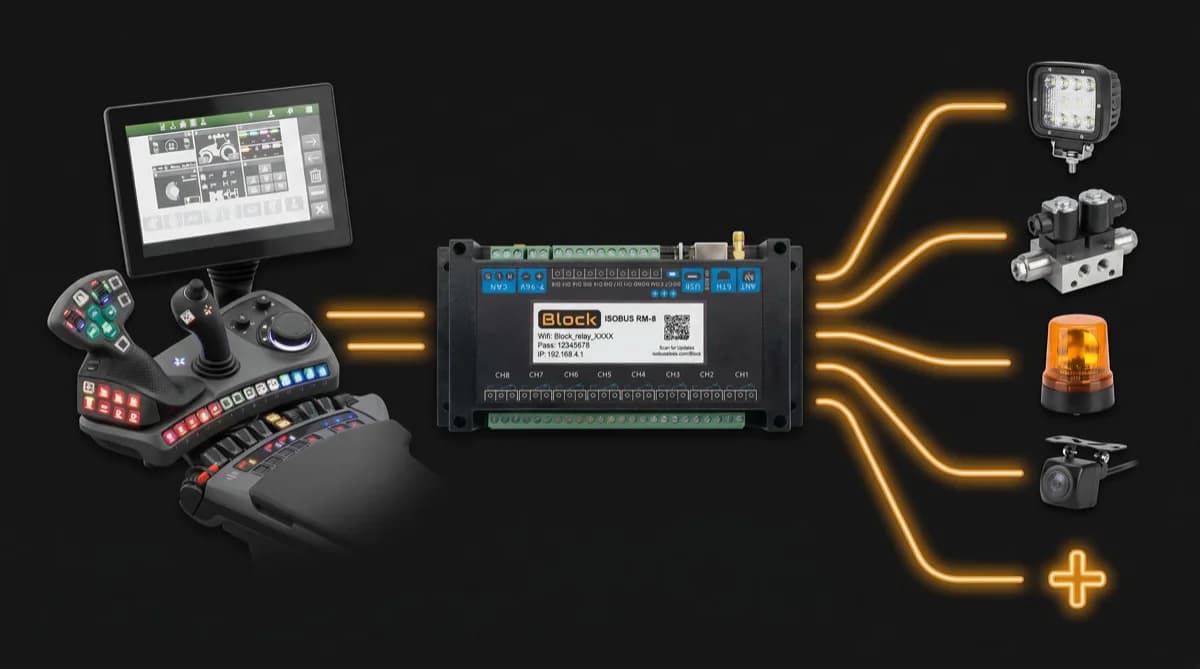
ISOBUS Block speaks the VT and AUX-N layers. It plugs into the in-cab or the external 9-pin ISOBUS socket, claims its address, and uploads its screen to the terminal. Its buttons show up on any ISOBUS terminal, each switching a relay channel, CH1 to CH8, in TOG or MOM mode. Its functions appear in the AUX-N menu, so you can put a work light or a diverter valve on a joystick button. It is not a Task Controller client.
Frequently asked questions
Is ISOBUS the same as CAN bus?
No. CAN bus is the two-wire network underneath. ISOBUS runs on CAN at 250 kbit/s and adds address claiming, the Virtual Terminal, AUX-N, the Task Controller and the standard connectors. Every ISOBUS network is a CAN bus, but most CAN buses are not ISOBUS.
Is ISOBUS based on J1939?
Yes. ISOBUS grew out of SAE J1939 and shares its 29-bit identifiers, PGNs, NAME and address claiming, and SPN and FMI fault codes. The agricultural layers, such as the Virtual Terminal, AUX-N and the Task Controller, are ISOBUS's own.
Can I connect an ISOBUS implement to a J1939 tractor?
Not directly. A tractor with only an internal J1939 bus has no ISOBUS socket, no VT terminal and no AUX-N. You need a tractor with ISOBUS, or a retrofit that adds the socket, the implement bus and a terminal.
What speed does ISOBUS run at?
250 kbit/s, fixed. A device set to a different CAN speed will not communicate on an ISOBUS network.
Does a CAN bus tractor have ISOBUS?
Not necessarily. Most modern tractors use CAN internally, but ISOBUS needs an implement bus, a 9-pin rear or in-cab socket and a VT terminal. Check for the socket and an ISOBUS or UT entry in the terminal menu.
What is the ISOBUS protocol?
It is ISO 11783, the standard for communication between tractors, implements and cab terminals. It defines the connectors, the CAN network at 250 kbit/s, how devices claim addresses, the Virtual Terminal, AUX-N, the Task Controller and diagnostics.
Need an ISOBUS relay module for controlling solenoids, work lights, or hydraulic valves? ISOBUS Block provides 8 relay outputs controlled directly from your tractor's Virtual Terminal display.