In short: Automatic ISOBUS section control needs three parts: a Task Controller (usually in the tractor's terminal), a GPS receiver feeding it, and an implement ECU that speaks TC-SC. Both tractor and implement have to support TC-SC, so check the terminal maker's compatibility list and the implement maker's spec sheet before buying. A sprayer with plain section valves and no ECU is missing the third part.
Overlap costs money on every headland turn. Spray twice, seed twice, spread twice, and the double-dosed strip shows up in the crop and on the invoice. ISOBUS section control is the standard answer to that: the implement's sections shut off by themselves when they cross onto ground that has already been covered, and come back on when they reach clean ground.
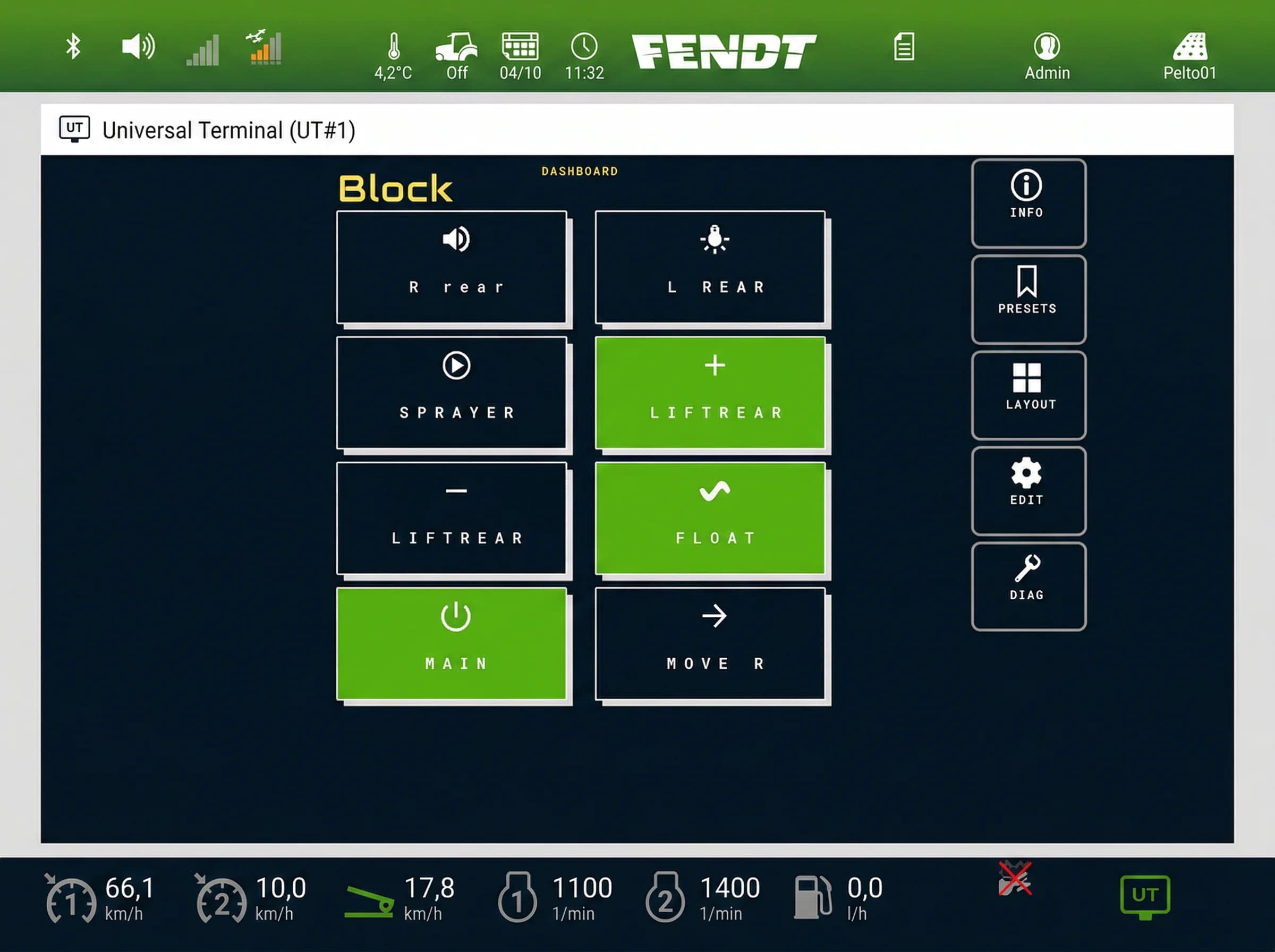
ISOBUS Block does not do automatic section control. It has no GPS input and takes no TC-SC commands. It puts each section valve on a relay channel and lets you switch it from the tractor screen or an armrest button. On an old trailed sprayer with four section valves, that is often the whole job. On a wide boom over irregular fields, it is not.
What Section Control Actually Switches
Section control means switching parts of an implement on and off based on where the machine is in the field. What counts as a "section" depends on the machine:
- Sprayer: a group of nozzles along the boom.
- Seed drill or planter: a row, or a group of rows.
- Fertiliser spreader: one side of the spread pattern, or a segment of it.
The Task Controller compares the machine's current position against the ground already covered and against the field boundary, then shuts off any section that would apply a second time. Turn into the headland and the sections drop out one after another as they cross the line. Drive back into standing crop and they come back on.
The mechanism behind it is the Task Controller defined in ISO 11783-10. TC-SC is the name used on spec sheets for section control, listed alongside TC-BAS and TC-GEO.
TC-BAS, TC-GEO and TC-SC: How the Levels Relate
Three Task Controller functionalities turn up on spec sheets and compatibility lists. They do different jobs.
| Functionality | What it does | What you get out of it |
|---|---|---|
| TC-BAS | Task Controller basic. Records totals for a task: area worked, product applied, time. | Documentation |
| TC-GEO | Position-based control. Adds the machine's position, so work is recorded and prescribed by location: prescription maps and variable rate in, as-applied maps out. | Maps in and out |
| TC-SC | Section control. Switches sections on and off from position. | Automatic overlap control |
In practice TC-BAS is the base. TC-GEO and TC-SC ride on the same device description and process data that TC-BAS uses, which is why a product certified for either normally carries TC-BAS as well. They are separate additions, though: TC-SC does not need TC-GEO, and TC-GEO on its own does not give you section control. What matters more for a buying decision is that both ends have to support the same functionality. A tractor certified for TC-SC paired with an implement that only speaks TC-BAS gives you totals at the end of the day, not automatic switching during it.
What an ISOBUS Section Control Setup Needs
Three parts have to be present, and on some brands a fourth. Miss one of the first three and there is no section control, however good the rest are.
- A Task Controller. Normally built into the tractor's terminal. It can also be a separate TC box, or an aftermarket terminal that carries one. This is the part that decides which section goes off and when.
- A GPS receiver. Its position has to reach the Task Controller, either over the bus or from a receiver built into the terminal. Correction quality matters: the steadier the position, the cleaner the shut-off line at the boundary.
- An implement that speaks TC-SC. The implement's ECU has to publish its section geometry (how many sections, how wide each one is, and where each one sits relative to the machine's own reference point) and accept on/off commands over the bus. A sprayer with plain manual section valves publishes nothing and hears nothing.
- An unlock, where the setup asks for one. On some terminals section control is a paid activation rather than a standard feature, applied by the dealer or through the brand's own licence portal.
Check both ends before you buy anything. Check the terminal maker's compatibility list and the implement maker's spec sheet, and see whether TC-SC appears against both. A machine missing from a list is not automatically a machine without the functionality. Check the manual as well. The ISOBUS compatibility guide walks through that lookup and what the entries mean.
If the implement is the missing piece, the fix is an ISOBUS implement ECU with a TC-SC client, not another terminal. That is a different product category from a relay module, and the ISOBUS gateway guide covers where those boxes sit on the bus. If you build the machine, ISOBUS software development for implement manufacturers covers what that ECU project involves.
Where ISOBUS Block Fits
Nothing inside the module knows where the machine is in the field. It is not a Task Controller client, it receives no TC-SC commands, and it has no GPS input.
What it does is switch. Each section valve gets a relay channel, CH1 to CH8 on the 8-channel module, and each channel gets a control: a button on the tractor's Virtual Terminal, an AUX-N assignment on a joystick trigger or armrest switch, or both. The operator decides when a section goes off.
That covers the section work an operator does by hand. Shutting the outer sections off before the headland. Killing one section over a ditch or a pond. Running a half-width pass down a wedge. The wiring is the same pattern as moving a sprayer's boom controls onto AUX-N buttons: the relay switches the solenoid coil, and the valves, hoses and plumbing stay as the machine maker built them. Setup is the same as any other output. Press EDIT, name the button, pick its icon, choose which channel it switches, set TOG or MOM, then assign it in the tractor's AUX-N menu.
Sensor-Driven Is Not Map-Driven
The 8-channel module has digital inputs, and they are easy to mistake for section control. A sensor wired to a digital input can drive a channel through the AUTO feature: set that input to FOLLOW mode, arm the tile from the screen or an AUX-N button, and the channel follows the sensor for as long as the tile stays armed. A pressure switch, a float switch, a proximity sensor on the fold frame.
That is sensor-driven, not position-driven. There is no map, no field boundary and no GPS anywhere in it, so it is not section control and should not be described as such. Manual control always wins: touch a control that overlaps an armed tile and the tile disarms, and the automation never resumes on its own. The 32-channel module has no digital inputs, so this path exists on the 8-channel module only.
Which One Do You Need?
| Map-driven TC-SC | Manual switching on a relay module | |
|---|---|---|
| What switches a section | The Task Controller, from GPS position | The operator, from a screen button or an armrest button |
| Needs a GPS receiver | Yes | No |
| Needs a TC-SC implement ECU | Yes | No |
| Handles point rows and odd headlands | Yes, that is the whole point | Only as well as you can judge it from the seat |
| Produces as-applied documentation | Yes, where the setup also carries TC-BAS or TC-GEO | No |
| What you are buying | Terminal, receiver, implement ECU, activation where required | One module, wired to the valves that are already on the machine |
Pick TC-SC when overlap is genuinely costing you: expensive input, wide boom, irregular fields, long days where anyone's attention drifts. On a big self-propelled sprayer running high-value chemical, automatic shut-off earns its keep.
Pick manual switching when the machine is older, the sections are few, and a TC-SC retrofit costs more than the implement is worth. A trailed sprayer with four section valves and no ECU is the clear case: four relay channels, four armrest buttons, and the operator shuts the outers off at the headland the way they always have, minus the aftermarket switch box screwed to the cab. It will not match TC-SC on a wedge-shaped field. The ISOBUS retrofit guide covers the wider wiring picture for that job.
You can also run both on the same machine. The implement's own ECU keeps doing the spraying and the section control, and the relay module switches the things nobody built an ECU for: work lights, a diverter valve, a tank rinse valve, a beacon. Each device claims its own address and shows up as its own working set, and you switch between them on the terminal the way ISOBUS terminal solutions describes.
Frequently Asked Questions
What is ISOBUS section control?
ISOBUS section control is the automatic switching of implement sections on and off based on GPS position, so the machine does not apply a second time on ground it has already covered. TC-SC (Task Controller Section Control) is the name used on spec sheets for the functionality; the Task Controller it runs on is defined in ISO 11783-10. The tractor's Task Controller reads the position and the coverage, and sends on/off commands over the bus to an implement that supports TC-SC.
Can an ISOBUS relay module do automatic section control?
No. A relay module like ISOBUS Block is not a Task Controller client, receives no TC-SC commands and has no GPS input, so it cannot switch sections from position. What it does is put each section valve on a relay channel and let the operator switch it from a button on the tractor screen or an AUX-N button on the armrest. That is manual section switching, not automatic section control.
What do I need for ISOBUS section control on my sprayer?
Three, plus a fourth on some brands: a Task Controller (usually in the tractor's terminal), a GPS receiver feeding it, a sprayer whose ECU supports TC-SC and publishes its section geometry, and an activation on the terminal where the brand requires one. Check the terminal maker's compatibility list and the sprayer maker's spec sheet, and check that TC-SC appears against both. If the sprayer has plain section valves and no ECU, that is the piece to solve first.
What is the difference between TC-BAS, TC-GEO and TC-SC?
TC-BAS records task totals such as area worked and product applied. TC-GEO adds position, so work is documented and prescribed by location, which is what variable rate from a prescription map needs. TC-SC is the one that actually switches sections on and off from position. A machine can have documentation without section control, so check the specific functionality rather than assuming "Task Controller" covers all three.
Can I switch sprayer sections from my armrest buttons instead?
Yes, with a relay module. Wire each section's solenoid valve to its own relay channel, then assign each channel to a joystick or armrest button through the tractor's AUX-N menu. The sections then switch from controls you already have, by hand as you drive. It covers headland shut-off and skipping a wet hole, but it does not draw a boundary or read a map, so it will not catch the overlap on a point row the way TC-SC does.
Is an ISOBUS section control system worth it on an older sprayer?
Often not. A full ISOBUS section control system means a Task Controller, a GPS receiver, an implement ECU that publishes section geometry, and an activation on some terminals. On a trailed sprayer with four section valves, that adds up to more than the machine is worth. Four relay channels and four armrest buttons give you headland shut-off and skipping a wet hole for the price of one module and the wiring. The trade is that you judge the boundary from the seat instead of from a map, so overlap on point rows stays with you.
Need an ISOBUS relay module for switching section valves, work lights, or hydraulic solenoids from the tractor screen? ISOBUS Block is an 8-channel module, 10 A per channel, controlled from your tractor's Virtual Terminal and AUX-N buttons. The switching is manual: the operator decides, not a prescription map.